Vol. 8 No. 1 (2025)
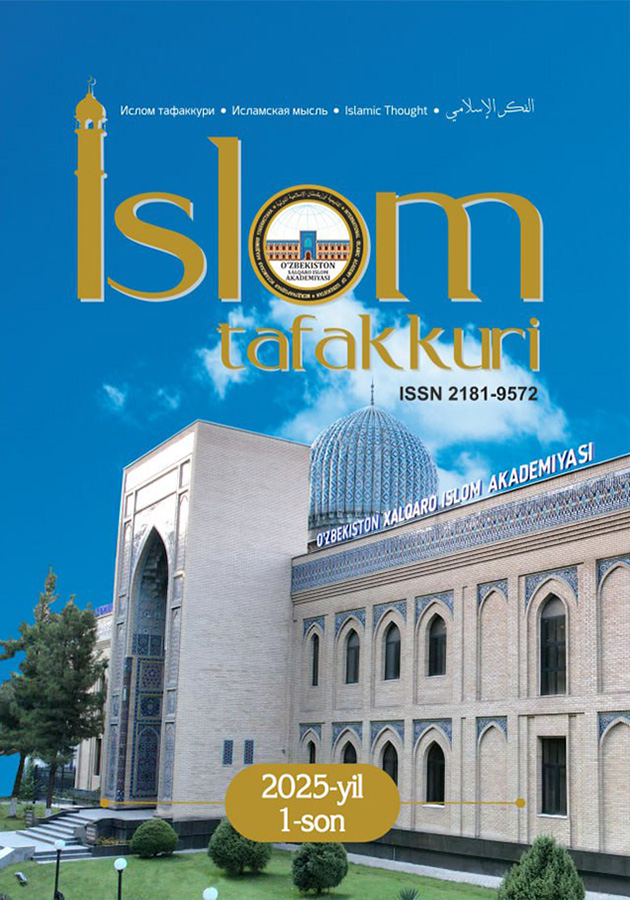
Articles
THE NECESSITY OF LOGIC AS A SCIENCE
Abstract. This article analyzes the formation of logic as a discipline and its role in the Islamic world. Although logic, as a field that studies the rules of correct reasoning, was initially developed by the ancient Greek philosopher Aristotle, it was extensively studied and systematized by Muslim scholars during the Abbas id period. The article examines the views and works of prominent thinkers such as Abu Nasr al-Farabi, Ibn Sina, Imam al-Ghazali, and Ibn Rushd on logic. Additionally, it explores the theories on logic presented in Ubaydullah ibn Mas ‘uds work Ta ‘diI al- 'Glum.
“AL-MUSTAQSĀ FĪ AL-AMTHĀL” – A TREASURY OF ARABIC PROVERBS
This article provides information on the general content, structure, and number of proverbs presented in Mahmud az-Zamakhshari's famous work “al-Mustaqsa ft al-amthal”. The book compiles widely known proverbs from ancient Arabic literature, analyzing their semantic and stylistic aspects. The article explores Zamakhshari s purpose in writing the work and the arrangement of proverbs into chapters. Additionally, it provides detailed information about the surviving manuscripts of “al-Mustaqsa ftal-amthal”.
ALGORITHMS FOR DETERMINING ILLEGAL ACTIVITIES IN THE NETWORK IN PROVIDING INFORMATION SECURITY
Algorithms for detecting illegal activities in the network are mentioned in this article. Currently, the development of economic and social spheres of any country cannot be imagined without modern information technologies. For this reason, the demand and need for information in the whole world is increasing day by day. In particular, the development of information technologies is the reason for the increase in the volume of data. This, in turn, requires a different assessment of information, that is, looking at it as content and creating new relationships, as well as identifying illegal attacks on information. The inbound filters in the aforementioned algorithms increase network security and help with security planning to manage traffic flow. They allow only secure and trusted networks, hosts or autonomous systems access to a secure network, use routers to restrict traffic and define rules and policies that govern a particular port, service, server or network
SOME ASPECTS OF THE OF ARTIFICIAL INTELLIGENCE TECHNOLOGIES IN EDUCATION
The article discusses digital technologies, artificial intelligence systems, the use of artificial intelligence systems in education, tools of the educational system, the advantages of artificial intelligence systems, digital platforms, their use, areas of application of artificial intelligence (Al) in education, the use of digital technologies in the management of higher education institutions, technological solutions for the use of artificial intelligence systems, as well as virtual tutors.
CHARACTERISTICS OF THE PREFACES OF SHAHRISTANI’S WORK “AL-MILAL VA-N-NIHAL”
The article examines the most important parts of the prefaces of the work "al-Milal wa-n-nihal ” by Abul Fath Shahristani, a unique creation in the study and classification of the history of religions. The significance of the styles in the prefaces of the work in the classification of religions and their scientific objectivity is analyzed. In addition, the article contains a short biography of the author and some information about his scientific heritage.
SCIENTIFIC HERITAGE OF MUSLIM SCIENTISTS IN THE XI- XII CENTURIES IN COMPARATIVE RELIGIOUS SCIENCE
The academic discipline that studies the history of religions, associated processes, and the interaction of religion with various aspects of human life is called “Religious Studies”. Like all social sciences, Religious Studies has its own object of study. In addition to examining the origin, social significance, and role of religion in society, it scientifically investigates the emergence and development of religious beliefs and their evolution throughout societal development. This article provides information about the works related to theology' and religious studies by scholars who lived in the Muslim world during the llth-I2th centuries. The article also discusses scholars who authored hooks in this field even before al-Biruni and Ibn Hazm.
SYSTEM OF SCIENTIFIC CONCEPTS DETERMINING THE STAGES, STRUCTURE AND CONTENT OF POLITICAL SOCIALIZATION OF STUDENT YOUTH
The article examines the system of scientific concepts that determine the stages, structure and content of students' political socialization. Particular attention is paid to the analysis of the key stages of political socialization: primary socialization associated with the acquisition of basic political concepts, values and norms, as well as secondary socialization, characterized by the development of critical thinking, personal political positions and the ability to consciously participate in political processes.
FEATURES OF ISLAMIC EDUCATION IN POST-SOVIET RUSSIA
The article examines some aspects of the processes of formation and transformation of Islamic education in Russia, which began with the collapse of the Soviet Union and the subsequent renaissance in the religious life of this country. Changes in the system of providing religious education that occurred under the influence of modern trends and social challenges in this country are analyzed.
SOURCE STUDY ANALYSIS OF THE CHAPTERS ON CONSPIRACIES IN THE HADITH COLLECTIONS “AL-SIHAH AL- SITTA” AND ITS SIGNIFICANCE
This article provides an in-depth analysis of the chapters on Fitna in the “as-Sihohu-s-sitta ” hadith collections and examines their role in ensuring social and moral stability. Fitna is considered a phenomenon related not only to religious conflicts, but also to the complexities that arise in social, political, and economic issues. The significance of the hadiths included in the Fitna chapters by Imam Bukhari, Imam Muslim, Imam Tirmidhi, and other hadith scholars is revealed. The article serves as an important source for researchers and students who wish to stud)’ the impact of the Fitna chapters on religious and moral life.
ABOUT THE SCHOLARLY ACTIVITY OF IMAM DORIMY
This article explores the life and scholarly contributions of the renowned hadith scholar from Samarkand, Abdullah ibn Abdurrahman Dari mi. The author examines his role in hadith science, views on the reliability of transmitters, and the significance of his works, particularly "Sunan. ” Insights into his piety, expertise as a hadith memorizes and judicial activities are also provided.
THE IMPORTANCE OF LEARNING FOREIGN LANGUAGES IN THE 21st CENTURY AND EFFECTIVE TEACHING METHODS
This article discusses the importance of language learning in today s world and the teaching of foreign languages to young people using modern methods and technologies in the digital era. It also provides information about the most popular online platforms and their capabilities. Additionally, the article highlights the significant increase in attention to language learning in our country in recent years, supported by specific examples.
IBN ABDULHAKAM AND HIS WORK “FUTUH MISR VA AKHBARUHA”
This article discusses the life, works, and the views of famous historians on Abdurahman ibn Abdullah ibn Abd al-Hakam, who lived and worked in Egypt under the Abbas id Caliphate in the 9th century. The article is based on the historical sources and scientific literature of the time. Additionally, it focuses on the content, structure, and scholarly significance of his work “Futuh Misr vaAkhbaruha ” ("The Conquest of Egypt and Its Reports ”). Information about the existing manuscript copies and modern publications of this rare work is also provided.
INSPIRED BY NAVOI
The article discusses the life and scientific work of the scholar-specialist in Navoi studies, Suyunia Ganieva, in the fields of literature, oriental studies, source studies, and textology. The article also highlights her collaboration with foreign scholars, the works published abroad, and her literary achievements, which have received high recognition both in our country and abroad.
THE ROLE OF TECHNOLOGY IN TEACHING PERSIAN: LANGUAGE LEARNING PROGRAMS, INTERACTIVE ONLINE LEARNING PLATFORMS
This article analyzes the importance of modern technologies in teaching Persian, in particular language learning programs and interactive online platforms. The article discusses the effectiveness, advantages and limitations of technological tools in the process of language learning and considers the issues of their integration into the educational process.
IMPORTANCE OF THE CHAPTER ON FITNAS IN IMAM BUKHARI’S “SAHIH-UL-BUKHARI” FOR PRESENT TIME
The article analyzes the content of the chapter "Fitnas ” in the work of Imam Bukhari and its significance for the present time. The concept offitna is explained in the Quran and Hadith, and the interpretation offitna is based on the Hadith. The views of famous scholars and leaders of the Islamic world, Abu Mansur Maturi, Mahmud Zamakhshai and Muhammad ibn Ismail al-Bukhari are presented. The article discusses the role of the hadiths in the chapter "Fitnas” in maintaining social and moral security in modern society.
LEGAL BASIS FOR TERMINATION OF LEASE AGREEMENT IN ISLAMIC LAW
This article discusses the legal basis for early termination of lease agreements in Islamic jurisprudence, including such issues as the completion of a certain period in the contract, requirements presented by one or both parties, the absence of afactor for drawing up the contract, the disappearance of the rental goods, the death of one of the parties, rendering the rental goods unusable and for other valid reasons that are considered invalid by decision of the qadi.
ANALYSIS OF SOURCES RELATED TO THE ADMINISTRATION OF MEDIEVAL CENTRAL ASIA
The article presents a source analysis of the history, style, content, manuscripts, translations, and modern editions of primary sources that provide valuable information about the history, culture, religion, rulers, social and economic situation, governance system, monetary and financial policy, tax collection, and other issues of the Samanids, Ghaznavids, Karakhanids, Seljuks, and Khwarazmshahs that ruled Central Asia in the 9th-12th centuries.
HISTORY OF ISLAMIC MONUMENTS OF TURKESTAN IN SOURCES
As a result of the reforms carried out in the modernizing Uzbekistan in the religious and educational sphere, the opportunities for studying the cultural and spiritual heritage of ancestors, comprehensively studying and promoting their culture, educating the younger generation as worthy successors of their ideas in the spirit of the times have expanded.
LIFE AND WORK OF SADRUSHSHARIA UBAYDULLAH IBN MAS’UD
This article is dedicated to the life and work ofUbaydullah ibn Mas 'ad, providing information about his academic path and his role in the Islamic world. The article also briefly discusses the scholarly legacy and works of this scholar. Ubaydulloh ibn Mas ’nd was a prominent faqih and mutakallim. His works, such as "Ta ’dilal-ulumfi-l-kalam ”and "Muxtasaral-viqoya, ” are considered major contributions to Islamic science.
SCIENTIFIC HERITAGE OF MUHAMMAD ALI SABUNI
This article analyzes the scientific activity, works and scientific heritage of Muhammad AU Sabuni, who was considered among the famous scientists of the Islamic world, despite being one of the modern scientists belonging to the people of Sunna and al-Jama ’a. Also, an attempt was made to reveal Sabuni s methods in the science of tafsir, which is the field in which he contributed the most to Islamic sciences, using his most famous tafsirs.
THE FORMATION OF ISLAMIC STUDIES IN THE UNITED KINGDOM
This article examines the formation and historical development of Islamic studies in the United Kingdom. The research addresses the initial stages of Islamic studies from the 16th-17th centuries, its evolution during the 19th-century colonial period, and contemporary trends in the 20th—21st centuries. The article analyzes the origins of Arabic language and cultural studies in Britain, the establishment of Oriental Studies departments at the Universities of Oxford and Cambridge, the contributions of prominent scholars, and the role of academic centers. Furthermore, the article highlights the significance of cultural and scholarly interactions between Britain and the Muslim world, while also exploring the methodological approaches and research directions within British Islamic studies.
ANALYSIS AND INTERPRETATION OF THE CONCEPT OF FATWA IN ISLAMIC SOURCES
Currently, fatwas issued by representatives of certain groups are causing Muslims to strayfrom the true essence of Islam and its authentic, pure teachings. Issuing fatwas on religious matters to others without cultivating the necessary’ qualities of profound knowledge, competence, and sincerity does not yield positive results. It is essential to eliminate such detrimental influences that undermine harmonious coexistence and mutual solidarity within society. This article examines the true essence of the fatwa, its various forms, and its impact on society. Information on the subject is drawn from research into the works of renowned figures in the Muslim world.
THE MAHBUBI’S FAMILY FAQIHS
Annotation. Many scholars of Islamic jurisprudence were active in Bukhara. Through their works and activities, they made a significant contribution to the development of Hanafifiqh. Among these scholars, there were many from dynastic families. For instance, the families of OH Moza, Hasiriy, Akili, and Mahhubiy are clear examples. Among them, the Mahbubiy family played an important role. Ubaydullah ibn Ibrahim. Ahmad ibn Ubaydullah, Umar ibn Ahmad, Mahmood ibn Ahmad, and Ubaydullah ibn Mas 'ud are prominent representatives of this dynasty. They left behind many valuable works on the science offiqh.
ABU MANSUR MATURIDI’S REFUTATIONS AGAINST THE KHARIJITES
This article discusses the Kharijites, their beliefs, mistakes, and misconceptions, as well as analyzes the perspectives of Imam Maturidi and Ahl al-Sunnah. It provides information on how Imam Maturidi refuted the Kharijites 'views, including their declaration of major sinners as disbelievers, their excessive reliance on their actions, and their denial of Allah’s mercy. The article also presents rebuttals to their incorrect interpretations using evidence from the Qur ’an and rational arguments.
HUKM AND HIKMAH: THEORETICAL FOUNDATIONS OF THE RELATIONSHIP BETWEEN SHARIA AND HAQIQAH
Annotation. This article explores the theoretical foundations of the relationship between Sharia and Haqiqah. It focuses on analyzing the connection between Sharia norms and the process of understanding truth through the lens of the concepts of hukm and hikmah. The study aims to identify the conceptual principles that bridge Sharia and Haqiqah within the frameworks of Islamic jurisprudence (fiqh) and the Sufi tradition. Special attention is given to the harmonization of the external legal precepts of Sharia with their inner essential meanings, illustrated through an examination of the views of various classical and contemporary scholars. Furthermore, the article substantiates that the grounding of hukm in the principles of justice and wisdom (hikmah) serves as a key instrument in the pursuit of truth. As a result, a deeper methodological understanding of the relationship between Sharia and Haqiqah is established.
THE CONCEPT OF FATE, THE ATTITUDE TOWARDS IT, AND THE PROBLEM OF HUMAN FREE WILL
Annotation. The purpose of this article is to scientifically study and compare the views of certain philosophers regarding the concept of destiny (taqdir) and, based on this, to draw scientific conclusions concerning the issue of destiny and human free will (ixtiyor erkinligi) in society. When the topic of destiny arises, [two questions emerge]: Firstly, if everything has been divinely predetermined, does human free will not exist? Secondly, if humans are free, what then is the meaning of predetermined destiny? It is important and relevant to derive scientific conclusions regarding these questions by studying the views of various philosophical schools and thinkers. Considering that the concept of destiny originates directly from religious teaching and in view of its influence on people s worldviews within society, some conclusions are also compared with religious texts and the views of philosopher-writers who have gained prominence in society.
DOGMATIC VIEWS OF ABU BAKR JASSAS
Annotation. The scientific heritage left by Abu Bakr Jassas (d. 370/981) is of special importance. AI lama made a significant contribution to the development of the Hanafi mazhab with his personal qualities, the teachings he received from the elders, the education of students, and the valuable works he wrote on fiqh.
This article analyzes the dogmatic views of Abu Bakr Jassas. It can be said that A Homa s dogmatic views were formed as a result of different events related to dogma and religious struggles and processes in the environment, based on the altitude of the era in which he lived. At the same time, it should be emphasized that the scientist s dogma did not go beyond the principles of the ahli sunnah wal jama ’ah.