Vol. 2 No. 4 (2019)
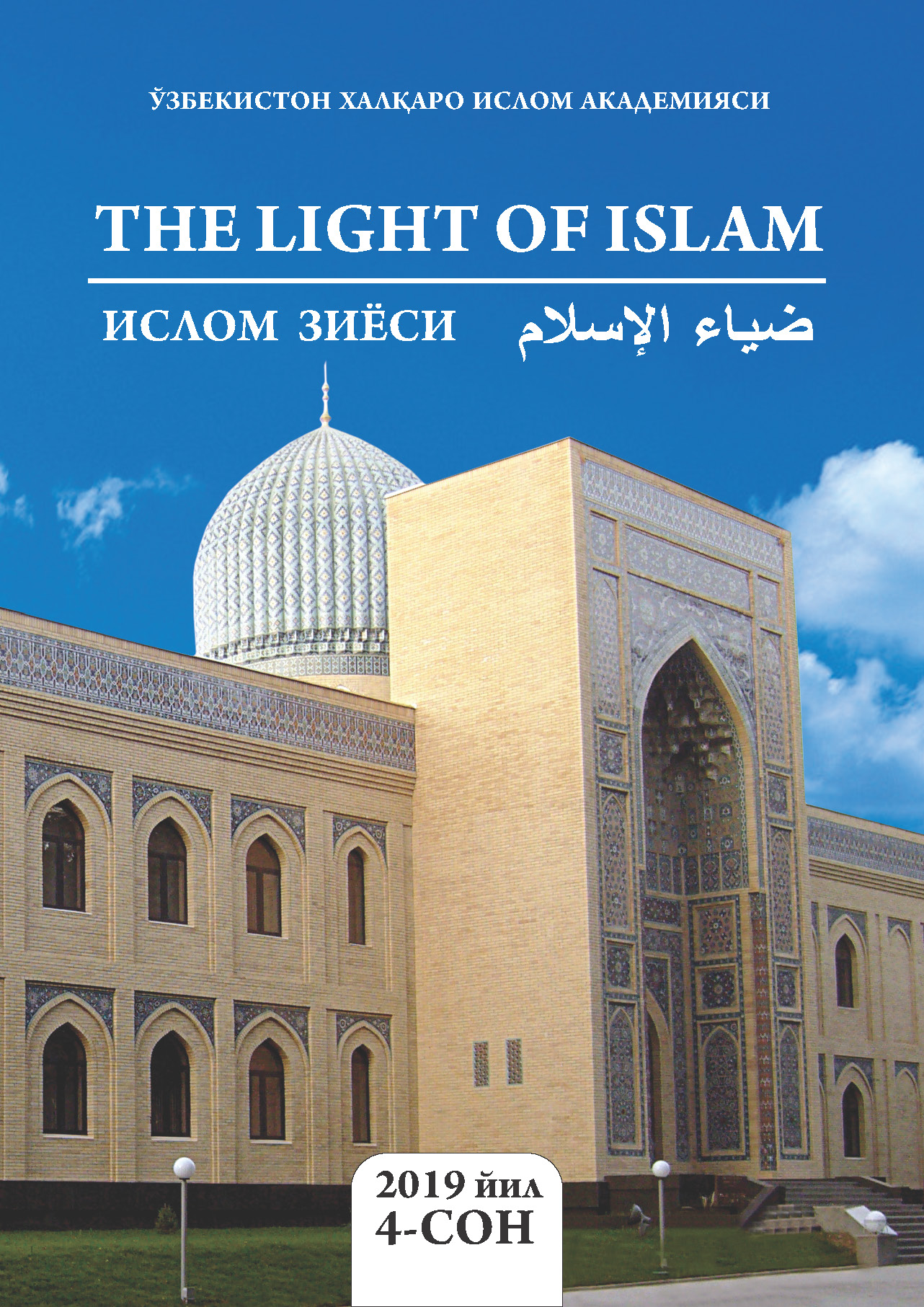
Articles
DISCLAIMER OF MISTAKES IN THESCIENTIFIC HERITAGE OF ABU-L-MU’INNASAFI IN DOGMA ISSUES (BASED ONTHE WORK OF «BAKHR AL-KALAM»)
This article provides information on the modern editions of «Bakhr al-kalam» attributed to the famous Maturidi scholar Abu-l-Mu’in Nasafi. The article is covered in the following publications: «Bakhr al-kalam», devoted to the study of the language, the study of Maturidite teachings, than the outstanding work of Abu-l-Mu’in Nasafi «Tabsirat al-adilla». A source of analysis of three modern and critical editions of «Bakhr al-kalam», based on the available manuscripts, and the most recent publication of books, which is considered easy to read, was carried out.
In addition, analytical information about the ideological role in dogmatic topics and in the struggle against modern extremist groups is covered. The article «Bakhr al-kalam» provides information on the exposure of the distorted dogmatic views of the Kharijits, as well as their misinterpretations in relation to the Qur’an and Hadith using the views of Abu-l-Mu’in Nasafi. In addition, authentic «Bakhr al-kalam» works are published on the basis of scientific analytical materials, which cite the ideas of the ideological refutation of lost beliefs, Hezbal-Tahrir and the modern-extremist ISIS group, which contradict the dogmas of Sunniism. Based on examples, the work «Bakhr al-kalam» is provided not only when studying the history of mankind, but also when revealing in it all aspects of the book devoted to the call for morality, the desire for enterprise and retention from carelessness.
THE ROLE ON THE COMPANIONS IN THE SCIENCE OF HADITH
The paper highlights the companions’ role in the Science of Hadith and definitions given by muhaddith scholars to them. Also it gives information about the requirements for being a companion of the Prophet. In addition, the methods of the recognition of the companions in the Science of Hadith were explained as well. Some opinions about the years which the companions claim to prove their company with the Prophet in the Science of Hadith were also given. although the companions were belonged to the same level in the history of the Science of Hadith, the scholars have divided them into the several groups during the study their history. Because it is a necessary factor for determining the authenticity of hadiths and choosing a certain companion’s saying to apply in the judgement. Among the narrators of hadith only the companions’ fairness is not discussed. It was analyzed through the examples and used in the books of Kalam as well. The number of the companions who narrated more hadiths were also given. As there were the companions who have given more fatwa since the period of the Prophet in the history of Islam, such kind of the prophets were given in the paper. Information about the number of the companions in the sources was analyzed. because women had an important place in the narration of hadiths, information about them was given as well. Their attempts in the study of hadiths were studied. The number of their narrations in some famous collections of hadith was analyzed.
The paper gives information about women narrators and their activity. Their works in the spread of hadiths are studied on basis of sources. The names of the women narrators who had narrated more than others are given. It is analyzed at the end of the paper that muhaddiths have given the names of the last companions.
SACRALIZATION AND TRADITIONALIZATION OF PERSONALITY ABU KHANIFA IN MAVARANNAHR
The life and work of Numan ibn Sabit Abu Hanifa has been thoroughly investigated and is still being studied. In independent Uzbekistan, as well as in the East and the West, an objective study of its life has already been established. No less important is the study of his scientific spiritual heritage. This article is an attempt to solve this problem: to objectively, without praise and moral assessments, analyze his scientific work, the attitude of a number of Muhandis to him in the process of disseminating the doctrine.
In the Muslim world, interest in the personality of Abu Hanifa has ancient roots. The first biographical book about him was composed by Ahmad ibn Salt more than a thousand years ago. Since then, the scientist’s biographies in the form of both separate books and articles in biographical collections have been written a lot. Unfortunately, some of them have not been preserved, and many have not yet been put into scientific circulation, having remained unreleased.
SA’DUDDIN TAFTAZANI –ENCYCLOPAEDIST OF THE SECONDEAST RENAISSANCE
The founder of the Timurid dynasty Amir Timur (1336-1405) united Central Asia and its neighbouring countries, attracted famous scholars and specialists in various fields of public sector and created favourable conditions for their activities from all over the conquered lands in the capital of Samarkand. After all, he was one of the most well-known rulers of his time, well aware of the importance of science in the development of the country and paid a great deal of respect to the scholars. As a result, there have been scholars who have mastered secular and religious sciences in various fields of knowledge. Through their efforts, education and science flourished and became an important factor in the emergence of the Second Renaissance in the East. Indeed, one of the encyclopaedists in this process is the scholar Sa’dduddin Taftazani, whose career was mainly held in the cities of Movarounnahr in particular in Samarkand in the famous Palace of Amir Timur. His full name is Mas’ud ibn al-Qadi Fahruddin Umar ibn al-Mawlah al-Azim Burkhonuddin Abdullah ibn al- Imam al-Rabbani Shams al-Haqq, ad-Din al-Qari as-Samarkand al-Hanafi al-Ajami was born in the village of Taftazan in Naso (nowadays Turkmenistan, Ashgabat) in Khorasan. He was a great scholar in the fields of morphology, syntax, maaniy, bayaan, usul al-fiqh, furu’ al-fiqh (hanafi and shafi’i), logic, aqidah, tafseer, geometry, astronomy, and other fields and at present his more than fifty works in various fields are preserved. This article describes the activities and academic legacy of this encyclopaedist.
IMAM BUKHARI’S METHOD OF JARH(ON THE EXAMPLE OF THE TERMS«MUNKAR AL-HADITH» AND «MATRUKAL-HADITH» IN THE «AL-TARIKHAL-KABIR»
Three well-known works of Imam Bukhari (810 - 870) which dedicated to the science of narrators of hadith that called «al-tarikh». They are «big» – «al-Tarikh al-kabir», «medium» – ‘al-Tarikh al-awsat» and «small» – «al-Tarikh al-saghir». The first two of them have survived to the present day.
al-Tarih al-Kabir is characterized by a wide range of topics and information contained therein. Perhaps that is why this work was called «The Great history». This book has great importance not only among the works of Bukhari, but also in the science of «jarh and tadil». It is one of the first sources of the science of transmitters. This is confirmed by the high evaluation of this work by scientists’ contemporaries of Bukhari as Muhammad Ibn Abu Hatim and Ahmad Ibn Muhammad Ibn Said Ibn Ukda.
To determine the author’s views on «jarh and tadil», as well as a specific method, it is important to analyze the terms of «jarh and tadil» which are used in relation to the transmitters in this work, as well as repeated in his other works. It is also important to find out whether the author or other muhaddith in his collections of narratives from the narrators to which the jarh (criticism) was applied. Because it reveals a particular style of Imam Bukhari in the assessment of narrators and the attention of other scholars to his views. In the article it is described the specific method of Imam Bukhari on the basis of the most strict critical terms of science jarh – «munkar al-hadith» and «matruk al-hadith» which is used in «at-Tarikh al-Kabir».
HAKIM TERMIZI’S PLACE IN THE SCIENTIFIC AND SPIRITUAL ENVIRONMENT OF CENTRAL ASIA AND CONTRIBUTION TO THE SCIENCES OF TAFSIR AND LEXICOGRAPHY
This article is consists of two parts, the first part is entitled «Influence of the Hakim Termizi Heritage on Sufi Environment in Maverannahra». It describes in detail, the influence of the views of Hakim Termizi on the Sufi environment in Central Asia, in particular on the dissemination of the ideas of futuwwa. Also, it is necessary to reveal how exactly the ideas of «futuwwa» are reflected in the works of Hakim Termizi. Thus, we directly refer to the work of Hakim Termizi and the work of modern scholars who have studied the scientific and spiritual heritage of Hakim Termizi. In addition, the first part represents the role of the ideas of Hakim Termizi on the formation of the principles of local tariffs in Central Asia during the formation of local sufi orders.
The second part of the article is entitled «The Place of Hakim Termizi in the Sciences of the Interpretation of the Qur’an and Lexicography», which examines the contribution of Hakim Termizi to the science of the interpretation of the Qur’an and the study of the vocabulary of religious texts. A series of works by Hakim Termizi on lexicography and interpretation are described. In particular, his work «Tahsil nazair al-Qur’an», which is devoted to meaningful words in the Qur’an, is compared with the similar works of previous scholars.
RELIGIOUS TOLERANCE CULTURE IS THE SUSTAINABLE DEVELOPMENT FACTOR
The article analyzes the objective and historical social development of tolerance and its importance in the modern human world, its compliance with the socio-historical status of society, international documents in this regard, and the initiatives of President Sh.Mirziyaev on the adoption of a special resolution «Enlightenment and religious tolerance». It also emphasizes that tolerance, particularly religious tolerance, is an important factor in the development of civil society in our country, with a strong emphasis on national traditions and values in their decision-making, and their integration with universal principles. In particular, the essence of tolerance in this regard is exemplified by the qualities such as solidarity, endurance, care, compromise that have been tested in our history. It is also suggested that the threats posed by intolerance are diverse, that they do not choose a nation or region, ignore national borders, have a universal character, and lead to intolerance and conflict. It was also studied positive mechanisms for forming a culture of religious tolerance in our society, especially of different religious groups, with their humanistic goals, a system of noble values and mutual respect, the establishment of ideals of religious tolerance, a healthy dialogue between religious confessions, and the role of structures in tools. There are also some theoretical conclusions and recommendations on the important principles of religious life in Uzbekistan, the importance of a culture of religious tolerance that strengthens the understanding, understanding and co-operation of representatives of different religions as indicators of community development.
THE STUDY OF IN THE WEST AND THE SCHOOLS OF SUFIZM
This article gives information on the reasons for the prevalence of Sufism in the West, its adaptation to secularization processes, and the growing interest in Sufism.
The problems, trends, stages and different perspectives of research presented by representatives of The School of Sufism in the West were studied in comparative-analytical study, showing the general and different aspects.
This article also focuses on the promoting methods of the representatives of Sufism in the West, their structure and their differences from traditional ones. Initially, the modern tariqa members caused the spread of Islam by promoting Sufism. But, nowadays, they are claiming that the religion does not interfere when one wants to join a tariqa. The article also covers the main goals of their actions.
There are also notes relating to the activities of the tariqas in the most free environment of Western countries, their influence on society, radical changes in their ideological foundations and the cases of deviation from the originality.
The concluding part of the article consists of the peculiarities of the study of Sufism in the West, the attitude of modern tariqa figures to Sufism and the emerging problems due to non-Islamic aspects.
SACRED PLACES OF NAKKSHBANDIA AND YASSAVIA IN NAVOI REGION
This article reflects the life and work of the scholars of the Naqshbandiya doctrine of Mavlana Arif Deggarani (1313–1375), Khodja Khusrav (XIV c.), Sheikh Nuriddin (XIV c.) and the sheikhs of Yassaviya Sayyid Ata (1318–1390), Badr Ata (XIV c.), Hazret Kasim Sheikh Azizon (1500–1578), who lived in the territory of the current Navai region and had a significant influence on the socio-political and spiritual life of Central Asia in the Middle Ages, and also presents some fragments from their activities cultural life of the country. It also provides information based on historical sources and archival documents on the development of the tarikat, which forms the basis of the activities of these scholars, their religious views and relations with the rulers. Information on the history of construction, location and the current state of shrines, mosques and chapels of Sufism scholars located on the territory of Navai region is analyzed.
CONDITIONS OF MARRIAGE AND CIRCUMSTANCES PREVENTING CONCLUSION OF MARRIAGE IN ISLAMIC LAW
Today, a comprehensive study of social aspects, cultural and spiritual, as well as socio-economic, legal, educational and organizational features of family relations is one of the questions of the hour. The relevance of the issue is that, first of all, at the present stage of development of our society, it is socially necessary to conduct a scientific analysis of the Islamic doctrine regarding family relations in the process of increasing the spirituality of the Uzbek people, including religious literacy. Secondly, when analyzing and studying the basic principles of Sharia norms, it is necessary to correctly use this knowledge in the search for solutions to issues, reasons, and the nature of growing family divorces, which is very relevant today. In this regard, this article highlights the essence and characteristics, as well as the socio-economic, spiritual and cultural foundations of the conditions and obstacles to marriage, in Islamic teachings, which were considered in the region as traditions. The article also examines and comparatively analyzes the religious, spiritual, legal, economic and educational factors of the conditions of marriage: free mutual consent to marriage, participation of witnesses in marriage, equality, makhr; circumstances that prevent marriage: a ban on marriage between relatives, issues of marriageable age under Islamic law with the norms of family law.
CODICOLOGICAL ANALYSIS OF MANUSCRIPTS OF WORK «AL-FIQH AN-NОFE’»
Movarounnahr is a place of scholars who have made a significant contribution to the development of Islamic sciences. The works of Islamic doctrines, rights and morals, written by scholars from this country, are popular not only in the Muslim world, but throughout the world. Examples include works stored in libraries around the world and recognized as rare manuscript sources.
One of such scholars is Abul Qasim Nasiruddin Samarkand. He lived in Samarkand in the 11th and 12th centuries, and studied Islamic sciences, in particular the Quranic sciences, doctrines, jurisprudence, ethics, history and lexicon, and contributed greatly to the development of science in Movarounnahr. The works of «al-Fiqh an-nofe’» are among the most important sources of Hanafi jurisprudence. This work is known as the science of fiqh and has been recognized by many scholars with commentary and commentary on it.
There are more than 30 manuscripts in the world’s libraries today. For this reason, the history of the writing of «al-Fiqh an-nofe’«, its structure, its manuscript copies, their source studies, and their specific features are researched and compared with historical sources.
A COMPARISON OF SOME OF THE FATWAS ISSUED BY THE MEDICAL AFFAIRS
In history and nowadays, in a constantly globalizing world, Islamic religion and medicine have provoked numerous heated debates, especially at critical moments in life and death, transplantation of human organs, abortion and other issues.
All Islamic law schools consider a woman’s life threat as an acceptable cause of abortion, and some allow abortion to preserve a woman’s health. Islam favors abortion under strict conditions, such as a risk to the mother’s life, a birth defect, and fetal deformity, or if pregnancy is the result of sin. Some ulema do not allow abortion to maintain a woman’s health.
An analysis of fatwas on the issue of artificial insemination shows that this process is permissible between a married couple, but donating a male sperm to a stranger in a Sunni madhhab is strictly forbidden and is tantamount to adultery.
Since organ transplantation is a relatively new and non-alternative method, some of the ulema have a negative attitude to this, but modern Islamic organizations consider organ transplantation to be permitted under certain conditions.
Surgery to correct an external defect or deviation aimed at improving the quality of life has been recognized as acceptable in a number of fatwas around the world. A contradiction in this matter exists in the plastic or cosmetic surgery, which is carried out in order to increase the attractiveness of a person.
ISLAMIC JURISPRUDENTIAL REGULATIONS ON THE ARIYAH AGREEMENT
In this article, the issue of aariyah (temporary gratuitous use of something) on social-legal relations in the sources of the classical period of the Hanafi sect, its lexical and stylistic meanings, as well as the understanding of the issue of aariyah according to Hanafi and other denominations of the Ahli Sunnah Wal Jama`ah are studied. According to Islamic law, the differences between aariyah, savings, pledge, lease agreements and the specific legal concepts are analysed comparatively. Also, the rights and obligations of the giver and the recipient of the aariyah are studied.
In this article, the issues related to aariyah in the works of fuqaha who were from Transoxiana and well-known in the Islamic world, including the work by Burkhaniddin Mahmud Bukhari “Muhit Burhani”, “Hidaya” by Burkhanuddin Marginani, “Mabsut” by Shamsul Aimma Sarakhsi, as well as among the scholars of the present time “Fiqhul Islam and adillatuhu” by Wahbatuz Zuhayl were analysed comparatively and conclusions were made.
ON SIGNIFICANCE OF SCIENCE OF BALĀǦAT IN ACHIEVING LINGUISTIC AESTHETIC PERFECTION
By the beginning of the 20 century the European scientists have begun to perceive the poetic ideas put forward in medieval Arabic language and literature including the science of balāǧat as a specific type of artistic expression. As a result, the Arabic poetic thinking and science of balāǧat in the medieval Muslim world began to be called canons.
Scientists agree that canons in literature are the product of certain type of social consciousness and caused by many objective factors. In the theory of medieval Arabic literature, development of poetic views on correlation between form and meaning was complicated. It is well known that the leading scientists of classical Arabic poetry of the 9-11th centuries considered that meaning and form had been interconnected. This outlook has formed the basis of their general philosophical views.
In all works on science of balāǧat, starting with Abdulkakhir Jurjani, correlation between word and meaning is necessary condition of sentence. The meaning, fccording in the Arabic Muslim philosophy is the main notion of the theoretical views. Literary canons, in turn, submit to the laws of language and cannot be achieved without them. The most important one among them is the systematic functioning of language as reflected in the theory of language system.
INCOMPLETE CONJUNCTION OF WORDS IN THE ARABIC GRAMMAR
One of the main issues in Arabic Linguistic is «grammatical status - إِعرابَ » (changing of the endings of words). «Changing of the endings of words» doesn’t mean changing the actual ending of the word itself (e.g.. the last letter), because the actual ending itself won’t change. What we’re changing here is the condition of the ending of words, which means that words transition from one state to another, regardless of whether that happens explicitly or implicitly. The great linguists of the Middle Ages Sibawaykhi, Makhmud az-Zamakhshariy, Abul Fatkh Mutarriziy, modern linguists Abbas Khasan, Mustapha Galayiniy, Russian scientists V.Girgas, B.M.Grande, N.V.Yushmanov, V.P.Starinin, G.Sh. Sharbatov and others paid more attention on this issue in their scientific works. Makhmud Zamakhshariy said: «First we have to know grammatical status – إِعرابَ because knowing of it helps us to understand other issues in grammar»
Almost all works of the Middle Ages linguists are begun with explanation of «grammatical status - إِعرابَ» The reason of this, one small mistake in grammatical status - إِعرابَ can change meaning of whole sentence. Grammatical status إِعرابَ shows noun cases and verb moods. The ضمة (damma) marks words in the nominative case, the كسرة (kasra) marks words in the genitive case and the فتحة (fatkha) marks words in the accustive case.
The present article gives more information about «grammatical status - إِعرابَ» in Arabic Linguistic.
AMIR HUSRAF’S LITERARY HERITAGE IN APPLIED ART RITUALS
In the article Amir Khusrav Dekhlavi’s huge heritage in the ruba’i genre is tried to study briefly. The aim of the article is to study the ideological and artistic system of the poet’s works, to identify the poet’s skills in the ruba’i genre, and also to define the role of his writings in the history of Persian-Tajik literature through analyzing his ruba’is. It is a scientific fact that he has profoundly influenced the other poets’ works in the Islamic region who wrote in Persian and Turkic afterwards. The interest to the poet’s writings, including his ruba’is, is related to the fact that the poet can create an independent school in the Middle Ages. Amir Khusrav wrote in all the genres of Persian literature in his time. He is also a rarely found philosopher in the field of ruba’i writing. The poet’s entire works are full of philosophical thoughts about the God, the universe, the human being, the life, the earth, the love, and has become a unique heritage due to the perfect choice of words in his works. The great accomplishments in this sphere are also appertain to the poet’s ruba’is. Although the subject of romance, which is characteristic of all types of poetry, is a dominant factor of his ruba’s, the area of social and philosophical thought is also extensive. He impresses people by the fact that he is a master of talent, who is capable of delivering any theme by his poems. It is evident that the ideas expressed in the article are aimed at determining the literary environment that poet lived and worked, their importance for the poet’s works and their role in the development of Oriental Literature.
CHRONOGRAMS OF RAJI MARGINONI AS A HISTORICAL SOURCE
The article gives information about the chronograms of the scientist Fakih and poet Khojojan Khoja - Raji Marginani (1834-1918). One of the talented representatives of the Margilan literary milieu, the end of the 19th and beginning of the 20th centuries, was a poet, scholarly enlightener - Raji Marginani, who became famous among the local intellectual circles under the name «Khojazhan Kazi». He continued the traditions of the Ferghana school in the fields of Muslim law (fiqh). Khojazhan Kazi worked in poetry under the pseudonym “Raji” (in Arabic, “Hopeful”). His legacy is undoubtedly of scientific interest. It, along with the common features inherent in Central Asian culture, contains its own color and peculiarity. It came in a straight line from the second righteous caliph Umar bin al-Khattab. Over the course of several decades, the ancestors of Rodji owned a leading position among the spiritual elite in the Ferghana Valley; they held the positions of Kazi-Kalyan of higher legal authority.As a poet, Raji continued and developed the best traditions of his predecessors. His work bore a pronounced social coloring. In the work of Raji, a whole gallery of satirical images of the oppressors of the people was created. Satire is essentially Raji’s main vocation. As the head of the Judges of the Ferghana Valley (Kazi-Kalyan), he perfectly knew the secrets of the Kazykhanas, the tricks of the Kazis. Most of the poems, especially Masnavi (couplet), Marsia – Tarih (chronograms) of Raji are purely philosophical in nature. The poet reflects on the essence of human life, on its transience. The activities and heritage of Raji Marginoni are important for the study and understanding of the spiritual and cultural life of the Ferghana Valley.
SOURCES OF «MAJMA‘ AL-MASAIL» AND POETIC INTERPRETATION OF THEQUESTIONS OF FIKH
Studying of philosophical and esthetic outlook of our people reflected in works of art is considered one of the major factors influencing on development of number of disciplines including the development of literary criticism and religious studies. In this sense, the careful and impartial research of such works remains to be one of the urgent tasks of literary criticism and source study in the period of independence.
In the article, sources of the work by the author under the pseudonym Afzaly «Majma‘ al-masail» devoted to fiqh questions and poetic interpretation of the matters are considered.
Questions of fiqh quoted in the margins of «Majma‘ al-masail» are the sources of the work as well. The majority of quotes are given in Arabic from the Koran, hadiths, rules of Sharia as well as from the works devoted to Islamic doctrines such as «Hayrat al-fuqaha», «Sharh-i avradiya», «Mukhtasar-i viqaya», «Al-Muhit», «Kanz al-ibad», «Fatavat al-amniya», «Salat-i Mas‘udiy», «Favayid», «Mukhtar al-fatava», «Favayid-i mukhtasar», «Masnaviy-i ma‘naviy», «Arba‘in», «Qazikhan», «Dajiziy» and «Khulasa».
SEVEN STAGES IN “MANTIC UT-TYRE” (“THE JOURNEY OF LOGIC”) BY ATTAR IN SUKHROB SIPEHRI’S POEM “ADRESS”
In the poem «Address», which was included in the collection «Green Volume» by S.Sepehri, in his own way he interprets the seven stages of asceticism - the «seven valleys», which are given in the dastan of Sheikh Fariduddin Attar «Mantik ut-tyr» («Journey of Logic»). The article provides a comparative analysis of the spiritual stages of the poet’s poetry - talab (need), ishq (love), marifat (enlightenment), isthiqno (denial), tavhid (unity), zairat (shock), fair (poverty) faqr fano (eternity). The path of Sufi perfection in the poem “Adress” is interpreted by the poet as a search for a “friend’s house.” In “The Journey of Logic,” the path through the seven valleys ends in the valley of “poverty and eternity.” Unlike Attar, Sepehri’s path to perfection does not end at the “eternity” stage. It develops cyclically. Each time, without reaching the end, the path to the truth begins anew in a new form.
ACTUAL PROBLEMS OF MODERN ARABIC LANGUAGE
The article is devoted to the study of the most actual tasks of Arabic linguistics, which until today have been of interest to Arabists throughout the history of Arabic linguistics. In this article we will consider only some of the most important problems of Arabic linguistics, which occupy a central place in the problems of issues relating to various aspects of Arabic linguistics.
At present, the problem of studying Arabic linguistics in the range of lexicography, territorial dialects, and modern Arabic literary language is relevant to modern Arabic studies.
The relevance of the work is determined by the fact that the study of the problems of the Arabic language are part of the problem of the modern linguistic theory of linguistics. The practical significance of the study lies in the study of modern Arabic literary language in relation to dialects, peculiarities of lexicology and phonetics, and the historical area of this problem is also affected.
Particular attention is paid to the linguistic situation in the Arab countries, the problem of overcoming obstacles to the creation of a common literary language, the lexicological peculiarity of the literary language and dialects is described, and the historical milestones of Arabic linguistics are also affected.
The purpose of the article is to analyze the study of aspects of Arabic linguistics, highlighting the basic structures of sociolinguistic and ethnolinguistic processes that have a direct impact on the language and its development.
The author focuses on the complex problem of differentiating territorial dialects (especially dialects of the Maghreb countries), disunity and the wide gap between rural and urban dialects from the literary language in phonetics, grammar, and lexicology. This problem has been little studied and requires further research.
The conclusion reveals the essence of the linguistic situation in the Arab region, describes the problems of Arabization carried out in the Arab countries, provides conclusions about the future of the Arabic language from the point of view of modern linguistics of sociology.
RELIGIOUS PRINCIPLES IN THE POLITICAL VIEWS OF AMIR TEMUR
This article explores the balance between religion and state in the politics of the great commander and statesman Amir Temur. It is revealed that in his political activities he was an accomplished figure who managed to incorporate Islamic law into the principles of the secular state. It has been studied comparatively that the government has followed the teachings of its teachers in the creation of just instruments and methods, and these religious and philosophical views have served as an important theoretical principle in the development of the country. This political philosophy of Amir Temur’s national statehood as a great historical and cultural legacy is the subject of much research today. It is becoming increasingly clear that the policy philosophy he has created has played an effective and positive role in the consolidation of interests, in achieving the highest goals of the people. Today, a number of sources and publications have analyzed the research that Amir Temur’s legacy has become a liberating idea in improving governance and public administration, balancing forces and interests, introducing sustainable development forms and tools, and exploring the philosophy of interethnic and interreligious tolerance.
Amir Temur is regarded as a historical figure, a great figure who understands the development of objective and subjective laws of the society, creates a perfect system for administering traditions and values in governance, creating tools that meet his needs, and introducing justice in public administration.
STAGES OF HISTORICAL DEVELOPMENT OF THE SYSTEM OF SELECTION OF LEADING PERSONNEL IN CENTRAL ASIA
The article is devoted to the study of the historical experience of Central Asia on issues of public administration, its organizational system, leading employees, their vibrators, selection and appointment. Taking into account information in this area, the author presents the main stages of the evolution of the formation and development of national traditions and values in the system of selection of heads of government and public administration. The article considers the following five stages of estorical evolution in chronological order using the structural and functional method, as well as comparative analysis: the first is the period from ancient history to the VIII century - the time for the practical implementation of leading cadres and officials; the second - IX-XVI centuries. - the period of development, formation and development of the national system of selection of leaders and officials in the public administration system, as well as the emergence of scientific theories and doctrines in this area; the third - from the 17th to the first half of the 20th century - the period of recession and recession in the national system of selection of leaders and officials in public administration; the fourth - the 20th century - 1925–1990 - the period of transition to communist totalitarian methods of selecting leading cadres and total rejection of the national system; Fifth - the end of the 20th century - the period of the revival of national roots and enrichment with world experience of the system for the selection and training of leaders in conditions of national independence.
PROBLEMS OF REGULATION OF SECULARISM AND RELIGIOUS PRINCIPLES IN ARAB COUNTRIES
The purpose of this article is to demonstrate that the wave of socio-political transformations that began in December 2010 in Tunisia and Algeria, called the «Arab Spring», was a phenomenon caused by a difficult internal situation, as well as internal and external factors that triggered these events.
The article examines the degree of influence of political Islam on the processes of modernization, geopolitics, as well as socio-political development, including the need to create a scientific basis for regulating religious relations in Arab African countries, which have become a source of instability. In this context, political processes in North Africa and the Middle East are studied. The processes of social and political transformations have influenced the political systems of Tunisia, Egypt, Libya and other Gulf countries.
Also, the result of social and religious unrest was the overthrow of the ruling regimes in Tunisia, Egypt, Libya. They led to changes in the ruling elite in Yemen and to this day the struggle continues between the Syrian government and the opposition. If the demonstrations against the regime in Tunisia, Egypt and Yemen were based on the internal socio-economic crisis, corruption of the ruling elite, the absence of genuine democratic freedoms and ethno-confessional confrontation, then the support of external forces was a key factor in Libya and Syria.
At the same time, changes in the socio-political situation in each of the countries of the region directly affect their neighboring states. Recent events in the Middle East and North Africa have created a more complex and interdependent situation, which has led to changes in the relations of security and stability not only in neighboring regions, but also in the world.
The influence of the «Arab spring» on North Africa and the Middle East is not the same. As a result of the political and economic upheavals of the Arab Spring, countries such as Tunisia, Egypt, Yemen, Bahrain, Libya, Syria were seriously affected by them. And on Morocco, Jordan, Lebanon, Algeria, Kuwait, Saudi Arabia and Oman, they had only a superficial influence.
These events spanned the entire Arab world, with the exception of Somalia, Mauritania and the Comoros, and led to a change in their political systems, structures, as well as the political future of states.
SPIRITUAL-MORAL ENVIRONMENT AND ITS BASIC INDICATORS
The article considers the problems of the spiritual and moral environment of society as a socio-historical phenomenon, the features of its development in a civil society and the laws of its development. The main attention is paid to ethical principles and means, ways to meet the needs of the individual, the importance of moral ideal, as well as objective conditions and subjective factors of the spiritual and moral environment.
In order to comprehensively improve the spiritual and moral climate in society, a philosophical approach to the question of the beliefs and beliefs of the individual was made in order to accept the moral ideal as the basis of the moral climate of society.
THE NEW PHILOSOPHICAL PARADIGM OF CULTURAL DEVELOPMENT
It is no secret that in recent еars the effectiveness of research in our country devoted to the study of social processes remains low. It is worth noting that many factors influence this. On the one hand, the active interaction of the international community and the waves of globalization go ahead than the development of diagnostic findings and the implementation of preventive measures in social research, and on the other hand, current studies lack clear scientific approaches and paradigms. Except for the requirement of a specific approach of the Higher Attestation Commission under the CM of the Republic of Uzbekistan, the scientific community (in most cases, even in its environment) did not come to a general scientific decision about certain paradigms. For this reason, substantial social studies characterizing the reality and developing appropriate effective measures are hardly noticed. This position is argued in the active journalistic activities of bloggers, rather than the academic community.
It is necessary to philosophical and conceptual analysis of “culture” in order to search for scientific solutions to existing problems, to provide a deeper understanding of social processes, and their organization in the direction of cultural development. This article is aimed at identifying deterministic relationships between different approaches to the concept of “culture” and, therefore, at developing a modern meritological paradigm for cultural development.
THE RELIGIOUS-PHILOSOPHICAL LEGACY OF AHMED ZAKI VALIDIY
This article analyzes the social and social life during the time of Ahmad Zaki Validi Togan, the religious-philosophical, socio-political views of A. Validi.
The emergence of the need to study the history of Islam and Christian doctrine, religious and philosophical thoughts by Ahmаdom Zaki Validi. Socio-political views of Zaki Validi on the political situation during the Soviet totalitarian politics based on an analysis of his views on the spiritual degradation of society, the moral impoverishment of people and the dependent of communist ideology among people of the former Soviet Union.
MORAL PRINCIPLES FOR ESTABLISHING RULES OF FAIR GOVERNANCE
The article discusses the role of ethical principles in the creation of management regulations. It states that governance based on established ethical values can serve as a legal basis for resolving various conflicts and disputes that may arise in society and is an important tool for ensuring good governance.
DEVELOPMENT OF CONCEPTS ON THE PHILOSOPHY OF RELIGION IN THE PHILOSOPHICAL THINKING OF THE WEST
This article explores the role of religious ideas, concepts and ideas in the cognitive process, the idea of God in the dominant idea of medieval Western civilization, as well as the philosophical views of theologians on the unity and eternity of God. The ideas of Thomas Aquinas about God, the omnipotence of God and his relative and absolute views on him are analyzed. The role of the theological doctrine in European philosophy of the 11th-13th centuries, its transformation into medieval European conceptual dominance was investigated in the theory of theology as a major scientific science with the addition of philosophy to its justification. Reflections on the creation of the doctrine of God in accordance with the criteria and standards of philosophical reasoning, evidence and systematization were analyzed using purely philosophical means, that is, regardless of the evidence and content of divine truth.
The article also considers the features of theism as a classical, traditional philosophical and theological teaching, the role of Brahmanism, Hinduism, Vedic teaching, Taoism, ancient Greek philosophy in the development of pantheistic ideas in Western philosophy. The influence of Augustine’s theocentric worldview on the development of the principle of the unity of God, the superiority of the soul over the body, will and feeling over reason in the philosophy of religion is revealed. It also analyzes the synthesis of the attitude towards religion of the Renaissance period with the conclusions of the natural sciences, criticism of medieval Catholic philosophy and culture, the emergence and survival of religion, as well as the inequality of economic and social development at the level of various peoples, social groups and individuals.
FORMATION OF A CLASS OF LOCAL OWNERS AT THE END OF XIX – THE BEGINNINGS OF THE XX CENTURIES IN THE BUKHARA EMIRATE
In article it is about formation of a layer of the local bourgeoisie and about activity of large owners in the Bukhara emirate of the end of XIX – the beginnings of the XX century. This article has the special importance because of it is writing on the basis of the comparative analysis of archival documents and historical researches.
The formation of local ownership in the Bukhara Emirate in the late 19th and early 20th centuries was largely dependent on economic and political factors in the region at that time. As a result of the establishment of the Russian empire’s protectorate over the Bukhara Emirate, Russian capital began to enter the Emirate. Russian and other foreign investors had to cooperate with the bourgeois representatives of the local population: traders, businessmen, wealthy men, owners of cotton and oil factories. Representatives of the first generation of uzbek investors formed in the emirate have competed and cooperated with other local owners in the region - the Turkestan governor general and the Khiva khanate. The Bukhara traders, the carpenter and the rich have worked in Turkey, Afghanistan, Germany, France, Italy and other foreign countries.
In Bukhara Emirate, have waqf lands for for hundreds of years, and the wealthy people and their heirs who have donated a portion of their property to the foundations have played an important role in the activities of Bukhara madrassas, mosques and other institutions. As a result of the income from the waqf lands, the expenses of the madrassahs were covered. In addition to muddarris and mulberries, other segments of the population (printers, eremites, darvish, etc.) also benefited from the foundation’s revenue. In particular, the contribution of foundation funds to the work of madrassas and mosques in Bukhara, the restoration and preservation of historical monuments, and the improvement of shrines and cemeteries played a positive role.
SOCIO-PHILOSOPHICAL ASPECTS OF THE SENUSITE MOVEMENT IN NORTH AFRICA
The great imam and reformer seyyid Muhammad bin ‘Ali al-Senusi was born in Algeria and is a direct descendant of the prophet Muhammad (peace and blessings of Allah be upon him). Received an excellent upbringing and education. He devoted all his knowledge and life experience to a noble cause: improving and reforming the hard and poor life of the simple Arab people. This is the period when European countries (France, Italy, etc.) began occupation actions against the underdeveloped Arab countries of North Africa. In 1830, the French captured Algeria - the homeland of Muhammad ‘Ali al-Senusi, and in 1881 the Arab country of Tunisia. Later, or rather, in 1911, the Italian colonialists, the fascist government of Italy launched armed aggression against the freedom-loving Libyan people. The national liberation movement of the peoples of North Africa against foreign invaders began.
The great Senusi painfully accepted the news of the occupation of a number of Arab countries, especially his homeland - Algeria, where he was born and studied, and where his youth passed .. He fully concentrated his attention on the liberation of the peoples of the Arab countries from foreign yoke and dependence, from hunger and poverty ... The first zawia was founded in ‘Abu Qubais in 1837 (Mecca), and the first zawia in northern Africa was built in 1843 and al-Beida’ (Cyrenaica), then the Great Reformer moved to Jagbub (1856). Subsequently, Jagbub turned into the central headquarters of the people’s militias against foreign invaders and became the center of the national liberation movement of the Arab people in the name of the liberation of the great Fatherland.
In the middle of the XIX century. in the most developed part of the Arab world (Egypt, Syria, Lebanon), a period of cultural growth began, called the Arab Renaissance (Nakhda). His ideologists sought to synthesize elements of eastern and western civilizations, focusing on the task of reviving the “glorious Arab heritage”, the former power of the Arabs in the economic, political and cultural spheres. In the ideological processes characteristic of the Arab Renaissance, a special place was occupied by the religious trend, represented by Islamic reformism.
THE CULTURAL LIFE IN SURKHAN OASIS: INFORMING OF ACHIEVEMENTS AND PROBLEMS BASED ON ARCHIVAL MATERIALS (1925–1941 YEARS)
It is important to say that This article is prepared on The cultural life in Surkhan oasis: informing of achievements and problems based on archival materials.
During these years, It was made actions to destroy the cultura of Surhan oasis after Soviet establishment.At the beginning It was propagandized as to start educating the local people and confused, as a result The local peoples had fallen into the degree of illiteracy.
The musical drama theater was one of the established cultural institutions, It was demonstrated interesting performances for local peoples there. The most of works which demonstrating at theater was been premiers promoting Soviet ideology.
It was operated consistently as the tasks of party and V.I.Lenin`s instructions in the main system of Government of Soviet. The local people`s religious affiliation was limited by Government of Soviet in all of district as It wa been in the country. As a result It was carried out widespread propaganda and outreach for excluding them from the people`s minds, suppressing of the people`s reaction to religious beliefs, creating of the society of «Godless».
It was formed communistic worldview and disrupted the rich culture of the population of oasis . It was organized clubs, red tea –house and other educational place of residence in all the district in order to promote Soviet idealogy as well as that it was consisted that people`s attention was focused on starting up of the politics of the cultural revolution by New Soviet government with fearing and keeping the people on a systematic basis.
THE WORDS THAT GIVES RELIGIOUS SENSE IN DRAMA PRODUCTS
In this article the use of religious concepts, their roles and methodical tasks are considered.This article deals with the role of popular expressions in speech of characters as expressive means, to increase the value of verbal art, in individualization of speech of characters, their figurative and emotional influence on the reader. Historical-religious words are not only used in the speech of the characters in their speech. There are some methodological goals that apply to them. The use of them can be attributed to the speech situation. They are bound by the process of the events and the mood of the speaker, their attitudes towards reality and their relationships. And most importantly, the historicity is envisaged. The antonyms of words that express religious convictions also have important methodological meanings. Whether they are in their sense or in a portable sense, the texts are brought to their intended purpose, and they can reasonably convey the speech of the speaker to the listener, and may also add to his mental changes. Antonyms are also an effective means of expressing their personality in terms of religious concepts.
CONDITIONS OF ENSURING THE INFORMATION-PSYCHOLOGICAL SECURITY OF THE PERSON
The aim of the article is to reveal some of the socio-psychological capabilities of protecting a person from informational-psychological threats. The article discusses the psychological possibilities of information and psychological security of a person. Humanity lives in the era of information technology, which accelerated the flow of information, which can change the mood, goals and aspirations of the people of the world, as well as the whole way of thinking. The article also notes that with the transition of mankind to the 21st century, it has been noted with unprecedented growth and quality of information, and today the impact, as well as the daily pressure, which is currently exerted by the foreign media is considered and perceived as aggression and psychological background. It is analyzed that some people, without thinking about the meaning, assimilate the materials and information presented by television channels as it is, moreover many people become victims of informational psychological influences as a result of their emotional, imaginative and satirical-humorous means. Such aspects as independence in the processing and selection of information, negative and positive consequences of informational psychological security are noted.
THE ROLE OF INFORMATION AND COMMUNICATION TECHNOLOGIES IN THE DEVELOPMENT OF RELIGIOUS AND EDUCATIONAL PROGRAMS ON ISLAMIC SUBJECTS
Modern information technologies make a significant contribution to the development of religious and educational programs. The electronization of the Qur’an, Hadith and historical manuscript sources remains relevant today. The software was created in order to present to the world the ancient works of our ancestors and present them to the next generation in their original form. These software packages can be used in Islamic educational institutions and courses. Modern programming languages, such as Php, WordPress, the Yii2 framework, Joomla, Visual Basic, C ++, were used in the development of Islamic sources. This article is devoted to the analysis of modern programming languages and Internet technologies aimed at creating and improving electronic sources on Islamic topics. The practical significance of the article lies in the use of modern information and communication technologies that support the work of electronic sources on the topic of Islam.
THE FORMATION OF ECOLOGY AND ECONOMIC MODEL OF THE MINERALS COMPLEX IN GLOBALIZATION
The purpose of the research is considers a role of complex of mining industry in economy of Uzbekistan, problems of the formation of ecology and economic model of the minerals complex, influence of the complex of mining industry on the country’s economic development. In order to achieve the purpose the following tasks were set out: study of sustainable development of mineral complex of Uzbekistan; assessment of the current situation of mineral complex on the base of the systematic research of the influence of the factors of economic growth, modernization of production; assessment of the potential for perspective development of the minerals complex in modern conditions; definition of priorities directions of development and the proposal of appropriate measures and mechanisms. This article discusses specifics of mineral resourses of Uzbekistan, analyzes experience of development mineral complex. This article is dedicated to the meaning importance, particularity and the priorities of sustainable development of the mineral complex of Uzbekistan in condition of ecologic situation.
The main attention was paid to the analysis of reasons and factors of ecologic problems and their influence of the development mineral complex of country. For the effective to make use of mineral resources important realize series arrangements: modernization and technique technological development of mining industry, minimization of negative effect ecological factors; pay attention to ecological aspects of social and economic development of mining industry on the local, regional and national levels; increase ecological security, monitoring of ecological threats, realization of complex arrangements for minimization of ecological threats and prevention of negative influence on economy of Uzbekistan; rehabilitation of the polluted territory and restoration of biosphere. The article presents some factors of sustainable development of mineral complex of Uzbekistan, including utilization of start-up, eco-innovations, expansion of activity of venture funds and improvement of infrastructure. Methods of research: systems analysis, comparative analysis, method of analysis and synthetic procedure, factorial method, including retrospective and perspective methods.
DIRECTIONS OF NATIONAL TOURISM DEVELOPMENT AND THE ROLE OF INTERNATIONAL EXPERIENCES
Measures are constantly being taken so as to develop tourism in the country as one of the strategic sectors that will contribute to the diversification of the economy, accelerated development of the regions, job creation, rise in incomes and living standards of the population, and improvementbusiness conditions in the national market. Therefore, liberalization of the visa regime, simplification of the registration procedure for foreigners, provision of privileges and preferences for the development of the tourism sector provide the opportunity to effectively promote the national tourism potential in the domestic and foreign markets.
The prior task is to create favorable conditions for the development of modern tourism, to improve the quality and competitiveness of services, to promote national touristic products, to facilitate the legal framework and hence, to implement the international standards, to develop the infrastructure, to train qualified staff, to diversify the tour-products and to form the country’s touristic profile as a safe destination for travel and leisure.
FEATURES OF FORMATION OF THE COMPETITIVE ENVIRONMENT IN SMALL BUSINESS IN THE CONDITIONS OF DEVELOPMENT OF INNOVATIVE ECONOMY
In a market economy, small business is the leading sector that determines the rate of economic growth, the composition and quality of the gross national product. The development and expansion of the sphere of production and services of small businesses in the Republic will eventually lead to an increase in employment and the development of the country’s economy as a whole.
Further enhancement of the role of small business in the national economy and further improvement of its participation in economic growth largely depends on the state of the competitive environment in this area. It is connected with creation of equal competitive conditions for functioning of business structures, improvement of tax system, elimination of financial problems and administrative barriers.
Accordingly, in the current conditions, the problems of determining the totality of factors affecting the formation of a competitive environment in small business, assessing the level of perfection of the competitive environment, the state of the competitive environment and its impact on the effective functioning of small business in Uzbekistan are of urgent importance.
The studied topic corresponds to the priority directions in the socio-economic sphere. Also, the goals and objectives set in the article are determined based on the requirements of the modern stage of development of the innovative economy. On the studied topic, scientifically grounded proposals on the peculiarities of the formation of a competitive environment in small business in the conditions of development of innovative economy are given.
FEATURES OF FORMATION OF THE CONCEPT OF THE NATIONAL INNOVATION SYSTEM
The article examines the formation of the concept of national innovation systems, its importance in modern economic theory and the history of the introduction of national innovation systems in economic theory and practice. The author analyzes different views on the national innovation system. The stages of development of the concept of a national innovation system are highlighted.
The issues of improving state measures to form the institutional basis of innovation policy are considered as an important tool to increase the effectiveness of the national innovation system. Based on the analysis of various views on the national innovation system, the author came to the conclusion that the national innovation system consists of the following four elements and their relationships: the structure of knowledge formation; technology transfer system; innovation financing system, innovation production system and innovative personnel training system. the article emphasizes that the state determines the main areas of support for innovation, the author has developed proposals for the implementation of measures to create, preserve and disseminate innovative knowledge and technologies, the formation of a national innovation system that unites all subjects of science and innovation management.
SPECIFIC ORGANIZATIONAL AND ECONOMIC ASPECTS OF THE DEVELOPMENT OF PILGRIMAGE TOURISM IN UZBEKISTAN
In the context of global economic innovation, it is important to study the methodological and practical aspects of this problem from the point of view of identifying trends and characteristics of pilgrimage tourism and improving the organizational and economic mechanism of its effective development. In our country, the government must create all the necessary conditions for the formation and effective functioning of the tourism industry, in particular tourism pilgrimages, also create a regulatory framework and take appropriate measures for the development and development of certain types of tourism. This will stimulate the development of tourism by creating an environment of fair competition among tourism entrepreneurs, which regulates the activities of tour operators and protects the rights and interests of tourists.
One of the important factors in the development of tourism in our country is peace, stability, mutual understanding and solidarity. Our country has long attracted people from the most developed countries of the world for its beautiful and diverse nature, rich history, architectural monuments and great scholars. It is noteworthy that the first step in the development of pilgrimage tourism to the country has been taken. With the initiative of the President of the Republic of Uzbekistan Shavkat Mirziyoyev, the first international tourism forum was held in Bukhara on February 21-23, 2019. In this article gives informtion about that the Republic of Uzbekistan establishes and develops relations with international organizations and foreign countries in the field of tourism, increases the flow of tourists to our country, creates all conditions for tourists, improves the quality and culture of services, and also provides the tourism industry. The organizational and economic aspects of tourism regulation are examined, as well as the training and education of specialists in this field.
FEATURES OF INDUSTRIAL DEVELOPMENT OF THE TASHKENT REGION
The article describes the features of the industrial development of the Tashkent region. Within one region, an industrial complex was analyzed. Some views of theorists on regional development are given. The opinions of these scientists on the factors affecting the development of industry in the region are analyzed. The economic potential and geographical location of the regions can lead to a clear division of the individual territories in industrial production. The economic and industrial potential of the Tashkent region was evaluated. It also analyzes the economic potential of the region. The role of regional sectors of the economy in the country is considered. It describes the economic potential of districts and cities, the availability of financial resources and the level of development of scientific and technological progress. It indicates the need to change the principles of state regulation of the scientific sphere for innovative development and the effective functioning of the region’s industry, foreign experience is an example of organizational and economic measures supporting the innovative development of the region’s industry. In conclusion, recommendations on the sustainable development of industry in the region are presented.
SOURCE STUDIES ANALYSIS OF MANUSCRIPTS OF “MUQADDIMATU-L-ADAB” IN FOREIGN ARCHIVAL FUNDS
Mahmud Zamakhshari’s scientific heritage are consist of about 70 works on linguistics and literary studies. The work of “Muqaddamatu-l-adab” has a special place in the scientific heritage of the scholar. This work, originally recognized as a multilingual dictionary, contains Arabic-Persian-Turkish trilingual, Arabic-Persian-Turkic-Mongolian in four languages. The work consists of five parts, in the first part presented words of noun, the second part is devoted to the verb and the words from it. The third part consists of auxiliary words, the fourth part is the formation of names and the fifth part is grammatical rules regarding the formation of verbs. There are such kind of manuscripts which included five parts of the work and manuscripts with separate grammatical parts in World funds. The vocabulary parts of the work have great scientific importance. Especially, Turkic dictionary in the manuscripts of the work is one of the most relevant and not investigated topics in world linguistics. Ten unique manuscripts of the Muqaddamatu-l-Adab dictionary are kept in Tashkent funds and sixty two copies which have been found currently in the funds of foreign countries. Most of them were copied in the 13th-14th centuries and serves as an important source for studying of Turkic language’s richness and meaning specificity in those periods. The earliest manuscript of the work is an Arabic-Persian-Turkic dictionary copied in 1257 in Khorezm and this copy is being stored in Turkey’s Suleiman Fund currently. The only copy of manuscript in Arabic-Persian-Turkic-Mongolian four-language, which was copied in 1492 in Bukhara is stored in the State Museum of Literature of Uzbekistan.
ACTUAL DEVELOPMENT TRENDS OF RELIGIOUS STUDIES IN UZBEKISTAN
The paper highlights actual problems, major directions and development trends of the field of Religious Studies in Uzbekistan. It is clear that the youths have become the main target of different destructive ideas in the period of globalization. The paper focuses on the prevention of these threats and formation of a spiritual immunity against them as well as on the improvement of healthy lifestyle and respect towards national and universal values in souls and minds of the youths in order to prevent a gap to be appeared in their spiritual world.
National and religious values have developed for better in Uzbekistan recent years. A special attention has been paid on the deep study and analysis of the religious-educational heritage of ancestors and continuation of their scientific traditions worthily. It was explained that the fact that increase of an interest towards a religion gives a chance to solve the modern complicated issues providing a harmonization of problems in society, thoughts about the solution of them, secular and religious values. Thousands of sects such as Christianity, Buddhism, Islam and other religions were emerged in the second half of the 20th century. The paper emphasizes a possibility to suppose that such kind of processes may be continued in the future. A special attention was paid on the formation of a critical and conscious approach in the youths towards religious news for choosing an objective way in the cyberspace and using the system of the modern information and communication technologies.


























