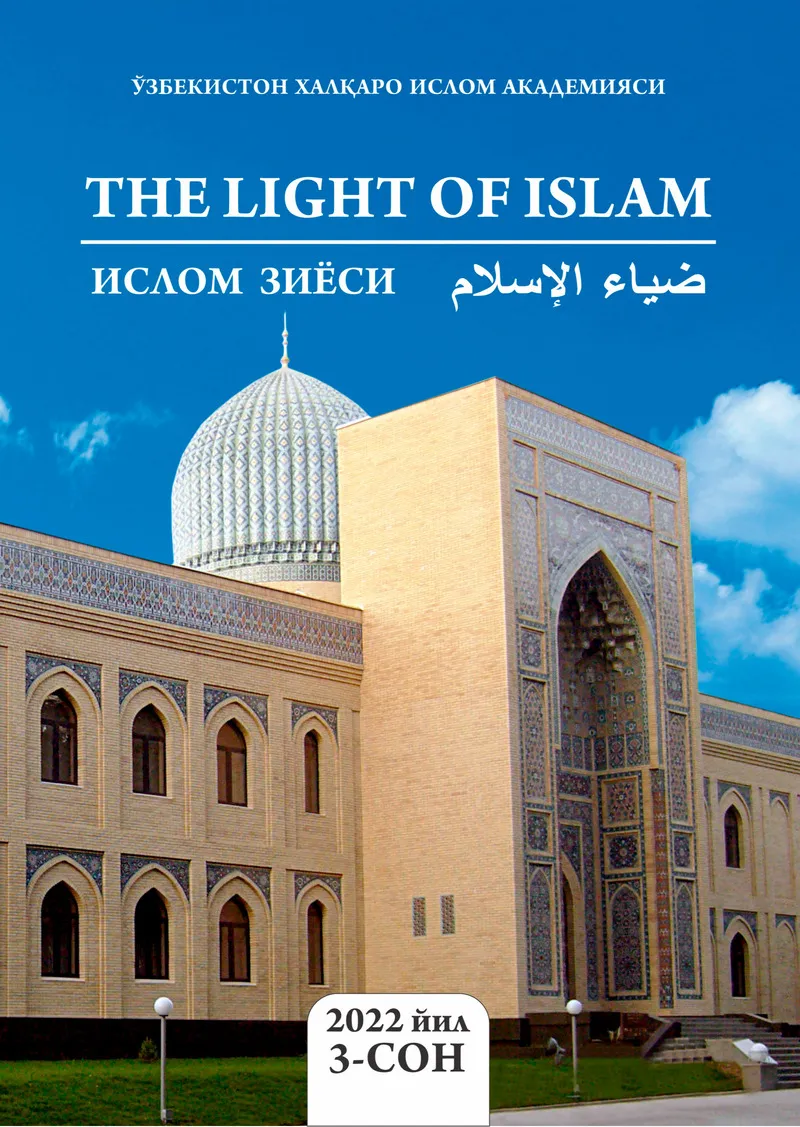
Current Issue
Articles
THE FORMATION AND DEVELOPMENT OF SCHOLARLY TRADITIONS OF ISLAMIC LAW IN MAWARANNAHR
This article examines the distinctive position of the Hanafi madhhab among other Islamic legal schools, intellectual traditions, and Sufi orders in Central Asia. The analyzed sources demonstrate that from the ninth century until the end of the thirteenth century, a continuous and enduring Hanafi scholarly tradition existed in Mawarannahr. Particular emphasis is placed on this aspect throughout the study. The article identifies prominent representatives of the madhhab, including muftis, mujtahids, teachers, authors of authoritative texts and works, as well as leading religious figures of their time. Information concerning their lives and scholarly activities has been collected and systematized. Drawing, first, upon the Hanafi intellectual tradition and, second, upon the analysis of the gathered materials, the study advances new scholarly conclusions regarding the history of these schools.
The article presents bibliographic information on the jurists who emerged from the schools of Samarqand, Bukhara, Shash, Fergana, Khwarazm, and Ustrushana, which were formed in Mawarannahr, and also discusses the significance of their works for the development of the science of fiqh in the region. The study further analyzes the political and social conditions in the region that played an important role in the rise of these scholars and in the dissemination of their writings across various parts of the Muslim world. Drawing on specific examples, the article examines how these factors contributed to Mawarannahr’s emergence as a center for the development of the Hanafi school of law between the eleventh and fourteenth centuries.
THE LEGAL STATUS OF KHABAR AL-WAHID IN SCHOOLS OF ISLAMIC JURISPREDENCE
This article provides a comprehensive theoretical analysis of the concept of khabar al-wahid (solitary report) and its status as a legal proof (hujja) in Islamic legal schools, along with the methodological criteria for its acceptance. Although khabar al-ahad (khabar al-wahid) is classified as a speculative (zanni) source of evidence within the framework of Islamic legal sources, its significant role in the derivation of practical Shari’ah rulings has been substantiated through scholarly analysis. The study comparatively examines the criteria for the acceptance of khabar al-ahad and the methodological approaches adopted by the Ḥanafi, Maliki, Shafi’i, and Ḥanbali schools of Islamic jurisprudence. The article elaborates in detail on the five unanimously accepted conditions for the acceptance of khabar al-wahid—namely, that the narrator be Muslim, sane, upright, truthful, and possess accurate retention (dabt)—as well as the additional requirements stipulated by the Ḥanafi and Maliki schools. While the Maliki jurists rejected reports that contradicted the established practice of the people of Madinah (amal ahl al-Madinah), the Ḥanafi jurists introduced additional conditions, including that the report should not pertain to matters of “umum al-balwa” (issues of widespread public concern requiring universal legal awareness), that the narrator possess juristic competence (fiqh), and that the narration not contradict firmly established Shari’ah principles. In contrast, the Shafi’i and Ḥanbali schools adopted a relatively broader acceptance of khabar al-ahad, considering the authenticity of the chain of transmission (sahih isnad) as the principal criterion.
The article also examines the methodological differences between the ahl al-ray and ahl al-hadith schools. It analyzes the relationship between khabar al-wahid and qiyas (analogical reasoning), with particular attention to the theoretical disagreement between al-Karkhi and al-Dabusi within the Hanafi school regarding the requirement that the narrator be a jurist. The study demonstrates that the differences among the jurisprudential schools did not arise from the rejection of hadiths themselves, but rather from differing approaches to their interpretation and application as legal evidence.
As a result, the study concludes that khabar al-wahid occupies a significant position within the system of Islamic legal sources, and that the differences among the jurisprudential schools reflect the richness and diversity of Islamic legal thought.
SPECIFIC FEATURES OF STUDYING, ANALYZING AND EVALUATING THE RELIGIOUS SITUATION
This article provides a comprehensive analysis of the theoretical foundations of the concept of “religious situation,” its structural elements, and its influence on socio-political processes in contemporary society. The study examines the interpretations of the concept of the religious situation in contemporary religious studies, sociology, and political science, and elucidates its essence on the basis of the theoretical perspectives of scholars such as Paul Tillich, A. N. Leshinsky, and R. A. Lopatkin. The author characterizes the religious situation as a complex social phenomenon associated with the influence of religion-related processes, within a specific territory and historical period, on the stability of social, political, economic, legal, and cultural relations.
Particular attention is paid to the analysis of the object, subject, actors, and internal and external factors shaping the religious situation. The article also explores the influence of state–religion relations, interfaith interaction, religious organizations, mass media, and online religious content on public life.
The study substantiates the significance of monitoring, assessing, and analyzing the religious situation for ensuring national security and maintaining social stability. Examples are provided from specialized research centers in the United States, Germany, the United Kingdom, the Netherlands, Egypt, Saudi Arabia, and Singapore that focus on religious-political processes, counter-radicalization, and deradicalization strategies. The article further analyzes the main factors contributing to the stability of the religious situation, including strengthening secular principles, guaranteeing freedom of conscience and religion, improving legislation in the religious sphere, promoting interfaith dialogue, disseminating the ideas of enlightened Islam, and preventing radicalization and extremism. The findings of the study demonstrate that the scientifically grounded management of the religious situation constitutes one of the key factors in strengthening social tolerance, civic cohesion, and socio-political stability within society.
CHARACTERISTICS OF SOCIAL INTEGRATION OF MUSLIM COMMUNITIES IN RELIGIOUS MINORITY CONDITIONS
This article provides a comprehensive scientific, theoretical, and practical analysis of the characteristics of the social integration of Muslim communities living under conditions of religious minority status. The study examines the sociological, political, and religious approaches to the concept of “religious minority” and explores the international legal foundations related to the protection of minority rights. The author analyzes the phenomenon of Muslim minorities within the context of globalization and conducts a comparative study of integration experiences in Europe, North America, South Asia, and Southeast Asia. Particular attention is paid to the positive experiences of Muslim communities in Canada and the United States, where Muslims actively participate in educational, economic, social, and political life while contributing to multiculturalism and religious tolerance. The article also highlights the participation of Muslims in democratic institutions in the United Kingdom and Germany as examples of successful civic integration.
At the same time, the study investigates the major challenges faced by Muslim minorities in France, India, China, and Myanmar, including discrimination, Islamophobia, political marginalization, restrictions on religious freedom, and identity crises. The theoretical framework of the research is based on the works of prominent scholars such as Tariq Modood, Jocelyne Cesari, José Casanova, and Yusuf al-Qaradawi. The article further discusses the concepts of fiqh al-aqalliyyāt (jurisprudence of Muslim minorities), inclusive secularism, intercultural dialogue, and civic integration as important mechanisms for addressing existing problems. The findings demonstrate that the successful integration of Muslim minorities contributes significantly to strengthening social stability, civic solidarity, democratic pluralism, and religious tolerance in modern societies.
CERTAIN ASPECTS OF IMPLEMENTATION OF SECULAR PRINCIPLES IN THE HEALTHCARE SECTOR OF NEW UZBEKISTAN
This article examines certain aspects of implementing secular principles in the healthcare sector of New Uzbekistan. The Constitution and legislative acts of the Republic of Uzbekistan firmly enshrine such values as freedom of conscience, the separation of religion and the state, and the promotion of interfaith harmony within society. The Law of the Republic of Uzbekistan No. LRU-1037, adopted in 2025 and entitled “On the approval of the concept for ensuring freedom of conscience of citizens and state policy in the religious sphere in the republic of Uzbekistan” constitutes an important strategic document that defines the legal, administrative, and ethical mechanisms for the consistent implementation of these principles. Chapter 6 of this concept is entirely devoted to the priority directions for the development of a secular state, while Paragraph 4 specifically emphasizes the implementation of secular principles in the healthcare sector. On this basis, the issue of strengthening secularism within the healthcare system is emerging as an extremely relevant matter not only from a legal perspective, but also from ethical, scientific, and cultural standpoints.
In the healthcare sector, the concept of secularism generally refers to ensuring respect for citizens’ rights to healthcare during the provision of medical services, adherence to medical ethical standards, and the grounding of all decisions in scientific evidence. In this context, the concept of “secularism” does not imply irreligiosity; rather, it denotes a priority approach grounded in human values and scientific solutions, irrespective of any religious belief. In this regard, priority is given to patients’ personal choice, informed consent, level of awareness, and legal guarantees in the provision of medical care. For this reason, the mechanisms for ensuring secularism in the healthcare sector, as outlined in the concept, require not only legal regulation, but also broad social, ethical, and educational reforms.
ABU’L-MA’ALI MUHAMMAD IBN UBAYDULLAH’S “BAYAN AL-ADYAN”: A SOURCE ANALYSIS IN EASTERN COMPARATIVE RELIGION
This article is devoted to the analysis of Bayan al-Adyan, the first comparative study of religions written in the Persian language by the 11th-century scholar Abul-Ma’ali Muhammad ibn Ubaydullah Husayni Alawi, who lived in Khorasan. Although information about the author's life is limited in the sources, the content of the work and certain data presented in it indicate that the scholar was close to the Ghaznavid court, held a high position in society, and possessed a profound rationalist mode of thought. The article examines the author's impartial exposition of various religions and sects, and in particular his methodology for classifying Islamic currents on the basis of the hadith of the "73 sects (firqas)." Drawing on the juridical (fiqh) and doctrinal indications contained in the work, the article substantiates Abu al-Ma'ali's own affiliation with the Sunni-Hanafi tradition.
The article also sets out in detail the historical circumstances connected with the fate of the work's manuscript copies, in particular the first critical edition prepared by the renowned Iranian historian Abbas Iqbal Ashtiyani, and the subsequent discovery of a complete copy of the work by Muhammad Taqi Danesh-Pazhuh. The work "Bayan al-Adyan" consists of five chapters in total and reflects not only religious teachings but also the geographical and anthropological conceptions of the eleventh-century Muslim world. Of particular note are the author's observations concerning the conceptions of the deity held by various peoples, including the pre-Islamic Turks and the Indians. As one of the most beautiful and rare specimens of the Persian language, the work has left an indelible mark on the tradition of the history of Islamic schools of thought (maqalat).
Among the sources of "Bayan al-Adyan" are cited the works of such thinkers as Abu Zayd al-Maqdisi, Abu Rayhan al-Biruni, Muhammad ibn Harun al-Warraq, and Abu al-Hasan Muhammad ibn Yusuf al-Amiri al-Nishapuri. In conclusion, the study reveals the structure of the work, consisting of five chapters, as well as the significance of the information it contains on pre-Islamic religions (Zoroastrianism, Judaism, Christianity) and on the false prophets who came forward with unscientific claims.
UNITWIN AS A PLATFORM OF ACADEMIC DIPLOMACY AND INTERCULTURAL DIALOGUE
The article examines the UNITWIN/UNESCO Chairs Programme as an instrument of academic diplomacy, intercultural dialogue and peacebuilding in the contemporary globalized world. The study aims to determine how the programme, established by UNESCO in 1992 as a mechanism of inter-university cooperation, has evolved into a channel of soft power that promotes mutual understanding, religious tolerance and a culture of peace through international academic collaboration.
The research employs a qualitative and interpretive methodology combining conceptual and documentary analysis. The theoretical framework integrates the concepts of soft power, the internationalization of higher education, intercultural sensitivity and peace research. The study also analyses UNESCO documents, the Bukhara Declaration on multi-faith dialogue and materials related to the UNESCO Chair in the Comparative Study of World Religions at the International Islamic Academy of Uzbekistan. Particular attention is given to the regional experience of Uzbekistan as an example of the practical implementation of academic diplomacy and interfaith cooperation.
The findings demonstrate that the UNITWIN/UNESCO Chairs Programme performs not only educational and scientific functions but also diplomatic and peacebuilding roles. UNESCO Chairs contribute to reducing cultural and religious stereotypes, strengthening interreligious dialogue, promoting global citizenship and fostering sustainable international partnerships. The article argues that universities and international academic networks can serve as non-state diplomatic actors capable of maintaining dialogue and cooperation even in periods of political tension.
The case of Uzbekistan illustrates how higher education institutions can support international peace and tolerance through comparative religious studies, intercultural communication and participation in global UNESCO initiatives. The study concludes that the UNITWIN/UNESCO Chairs Programme represents an effective model of academic diplomacy that combines educational cooperation with the promotion of intercultural understanding, peaceful coexistence and international solidarity.
IBN SINA’S EXOTERICISM IN METAPHYSICS AND THE INTERPRETATION OF THE WORLD
The misinterpretation of religious teachings worldwide, particularly the failure to approach the fundamental principles of Islam through rational inquiry, has led to the separation of religiosity and secularism, as well as philosophy and religion—a phenomenon observed both in the medieval period and in contemporary times. In such a context, the philosophical interpretation of Islamic teachings and the rational explanation of theological issues contribute to a more scientifically grounded understanding of these matters. Building upon the idea of Abu Nasr al-Farabi that “religion and philosophy are two paths leading to the truth,” the philosophical explanation of religious truths through rational principles contributed to the formation of a moderate approach to religion among people. Furthermore, the epistemological principles developed by Abu Ali Ibn Sina in the field of theology, together with his rational interpretation of religion, played a significant role in addressing and resolving the existing challenges. Based on this, the logical interpretation of religious truths, the use of rational principles in explaining the theological theme helps to correctly understand the issues of religion and philosophy.
There are many scientific research works in the world on the harmony of religion and philosophy, in which the philosophical teachings of Central Asian thinkers are studied as an important part of the spiritual heritage of this region. The study of the history of logical and epistemological ideas in Central Asia provides not only a deeper understanding of the philosophical and cultural heritage of the past, but also valuable insights into the ideological processes characteristic of the contemporary era.
Although Ibn Sina's theological heritage has been studied by a number of scholars from Western countries, Russia, Turkey, Iran, and Tajikistan, his religious and rational views have not been systematically analyzed. Previous studies have primarily focused on Ibn Sina’s views on the soul (nafs), spirit (rūḥ), and the eternity of matter.
However, the scholar's Islamic religious sources, in particular, his interpretations of the surahs of the Holy Quran, remain outside the attention of most researchers. As a result, in some studies, one can observe attempts to portray the scholar as a materialist and to interpret him as a successor of Greek philosophy. Therefore, studying Ibn Sina's interpretation is of great importance in rationally revealing the harmony of religion and secularism, as well as the principles of moderate Islam.
This article examines the interpretations provided by the eminent scholar and philosopher Ibn Sina on selected verses from the Qur’anic chapters Surah Al-Ikhlas, Surah An-Nur, and Surah Fussilat, which have been translated by the author of the present study.
FUNCTIONAL-SEMANTIC AND PSYCHOLINGUISTIC INTERPRETATION OF THE IMPERATIVE FORM (AMR) IN ARABIC RHETORIC
This article examines the functional-semantic and psycholinguistic nature of the category of Amr (the imperative), one of the central issues in Arabic rhetorical studies. In Arabic grammar (naḥw), the formation of the imperative is generally described through two principal forms, while comparatively little attention is paid in practical grammar to its expression through verbal nouns (maṣdar) and nominal forms (ism al-fi'l). Furthermore, the imperative verb is conventionally associated with "obligation" (wajub), implying a mandatory action.
The article analyzes four forms of imperative construction and provides a comprehensive examination of the meanings conveyed through each of them. The study conducts a comprehensive analysis of more than fifteen figurative and rhetorical meanings of the imperative form, demonstrating how its interpretation may vary according to the psychological state of the speaker and the communicative context. The analysis is grounded in the scholarly views of classical figures such as Yusuf al-Sakkaki and Mahmud al-Zamakhshari, as well as modern linguists including Ahmad al-Hashimi, Abdul Aziz Atiq, and Fadhil al-Samirrai. Based on these theoretical foundations, the study demonstrates the extent to which grammatical structures are conditioned by textual context and the psychological state of the addressee. The article comparatively analyzes the morphological and syntactic realizations of the imperative, ranging from the direct imperative verb to the future tense form combined with lām al-amr (the imperative particle), as well as verbal nouns (maṣdar) and verbal nouns functioning as nouns (asmāʾ al-afʿāl), and identifies their respective degrees of rhetorical and communicative effectiveness.
As the primary sources of analysis, the study draws upon a rich corpus of evidence from verses of the Holy Qur’an, Prophetic hadiths, and classical pre-Islamic (Jāhiliyyah) Arabic poetry. Through this analysis, the semantic layers of the amr category are elucidated, revealing its rhetorical functions in expressing incapacitation, advice, warning, disparagement, mockery, astonishment and wonder, regret, and declarative communication. In conclusion, the study demonstrates that, through the imperative form, a speaker not only motivates the addressee to perform an action but also influences and directs the addressee’s psychological state, while simultaneously conveying personal emotions, inner sentiments, psychological disposition, and communicative intentions. In addition, the article highlights the comparative distinctions of the imperative category in Arabic, Uzbek, and Russian languages. The study serves as an important scholarly resource for the accurate interpretation of religious and literary texts, as well as for ensuring their adequate translation.
THE PSYCHOLOGICAL PHENOMENON OF THE NEGATIVE IMPACT OF SOCIAL NETWORKS ON THE POLITICAL EDUCATION OF STUDENTS
The purpose of this article is to comprehensively analyze the psychological phenomenon of the negative impact of social networks on students’ political education and to develop pedagogical approaches aimed at minimizing such influence within the context of the Development Strategy of New Uzbekistan. The methodological framework of the study is based on the theoretical analysis of the works of Uzbek and foreign scholars in the fields of political psychology, pedagogy, and media studies; an empirical survey of 60 students of the Tashkent State University of Oriental Studies aged 18–23, including three diagnostic blocks (sources of political information, emotional reactions, readiness for inter-political dialogue); and an analysis of normative-legal documents, including the «Uzbekistan – 2030» Strategy, the Law «On State Youth Policy», and the Concept of Youth Education in the Spirit of Patriotism. As a result of the study, four principal psychological mechanisms underlying the destructive influence of social networks on students’ political consciousness were identified and systematically analyzed in detail: the formation of “echo chambers” and algorithmic ideological polarization; the development of clip thinking and the decline in the capacity for systematic political analysis; the emotionalization of political perception through dopamine-dependency mechanisms; and the emergence of an illusion of competence amid the superficial consumption of political content. The empirical findings revealed that 88% of respondents use social networks as their primary source of political information; 63% predominantly experience anxiety and anger while consuming political content; only 28% are willing to engage in constructive dialogue with individuals holding opposing political views; and 52% demonstrate elements of dehumanization toward political opponents. Based on the synthesis of theoretical and empirical data, the study substantiates the necessity of introducing an integrated pedagogical model for the formation of ideological immunity within the higher education system of Uzbekistan. This model encompasses a cognitive component (media literacy courses, fact-checking, and understanding of algorithms), an emotional-value component (interactive methods, debates, and role-playing activities), and a behavioral component (active civic engagement, volunteerism, and student self-governance). The practical significance of the study lies in the possibility of applying the developed recommendations in the activities of academic group advisors, instructors of social and humanities disciplines, specialists in educational affairs, and psychological services within higher educational institutions of Uzbekistan.