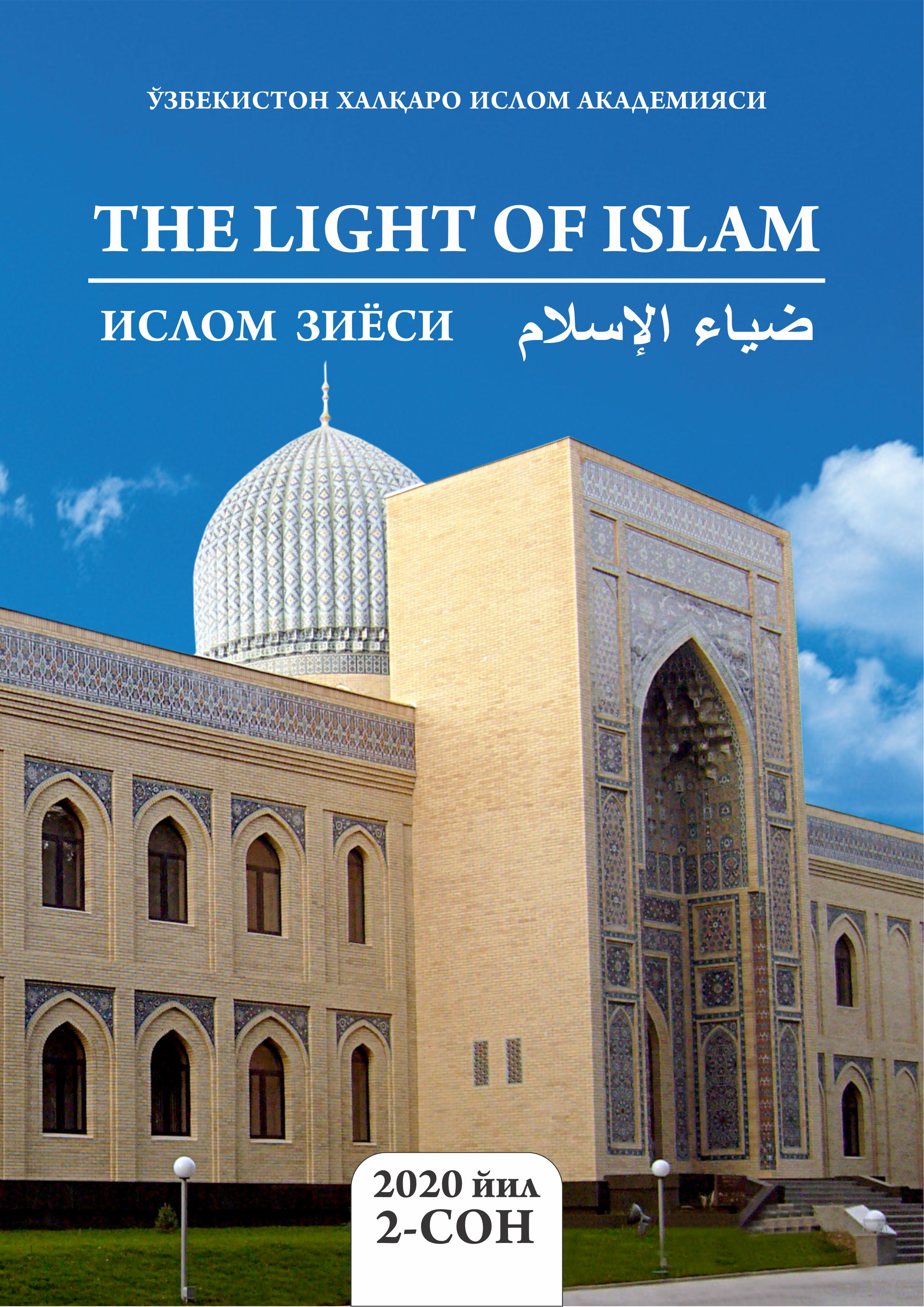
Vol. 3 No. 2 (2020)
Articles
SUBJECT: QĀDĪ’S DĪWĀN ACTIVITIES IN ISLAM (THE 10TH-13TH CENTURIES)
The article is based on most recent accomplishments, conclusions and methods in World Islamic and historical sciences. The historical-comparative method was applied to study the sources including various manuscripts of “Hanafi Law” and many other sources written in Arabic that are available in the Fund of Manuscripts of the Institute of Oriental Studies under the Academy of Sciences of the Republic of Uzbekistan.
It relies on recommendations, conclusions of research works and the conceptions related to the history of the civilization of the Central Asia that were stated by leading scientists of our country and foreign countries such as Schacht Joseph, Monika Gronke, Ulrich Rebstock, Chehata Chafik, Emile Tyan, Chalmeta P; Carriente F, Riberta J., Asin, Jeanette A. Wakin, Michael Thung, Wael Hallaq, Carl Brockelmann (Abū Nasr al-Samarqandi, Ed. Muhammad Jasim al-Hadisi, 1987, p.46).
The article aims to illuminate the role of literature on juridical documents in the development of divinity science in Transoxiana in X-XIII centuries. Moreover, to illuminate the importance of such works in regulating the social relations of the cultural life of our society. To highlight the historical-juridical forms, theoretical and practical foundation of juridical documents functioning in the world of Islam and Transoxiana in X-XIII centuries that was an important part of the social life.
TENDENCIES OF DEVELOPMENT OF THE HIGH TECHNOLOGY INDUSTRY IN THE TA SHKENT REGION
The article analyzes the number of innovative products and services produced by industrial enterprises and organizations of the region. In particular, the low share of high-tech industrial products in the industrial sector and its reasons are emphasized. The process of directing the costs of marketing, technological, and organizational innovations was analyzed to increase the overall proportion of the products of this sector. Also, the importance of creating innovative clusters in the region and improving the performance of small industrial zones was noted. It was mentioned that most of the costs of innovation are directed to industry, but most of these costs are in the low-tech sector. Directions of technological costs are listed one by one. In conclusion, the features of the industrial development of the region are summarized.
THE PREDICTED 2020 GLOBAL ECONOMIC CRISIS: CAUSES AND PROSPECTS
While the whole world is awaiting for the expected new economic recession 2020 that might lead to a financial crisis such as the 2008 crisis, this research paper addresses the indicators of this recession and its possible causes as well as the damages resulting from its occurrence and which countries are more affected by it, with a try to reach some recommendations to avoid this recession or dealing with it if it’s actually happens.
CREATION OF MOBILE APPLICATIONS FOR THE SHRINES OF AL-HAKIM AL-TERMIZI
We recognize that the sustainable development of tourism has great potential for the development of cultural and humanitarian ties around the world. We emphasize the importance of information technology in tourism, especially in the areas of advertising, marketing, differentiation and specialization of tourism products. In addition, we reaffirm our commitment to pilgrimage tourism for the individual growth of people and the strengthening of basic social norms and national values. The program uses modern programming languages such as Php, Java, C ++. Al-Hakim at-Termizi is one of the most famous places of worship in Uzbekistan, which is also known for its historical places in Termez, Surkhandarya region. The number of visitors to this temple is growing day by day. Currently, visitors need to use electronic information technologies to provide visitors with information about the pilgrimage site, which is a convenient way for visitors to access information about the pilgrim. And we are talking about the importance of developing an electronic guide for mobile devices during this visit.
CLOUD TECHNOLOGIES IN ISLAMIC EDUCATION INSTITUTIONS
Information and Communication Technology is making use of ICT tools to store and retrieves information. It plays An important role in growing and maintaining a country’s economic growth. One of the latest technologies prevailing nowadays is cloud computing. By sharing IT services as platform-based, software-based, and infrastructure-based in the cloud, educational institutions in Uzbekistan can now out-source non-core services and better concentrate on offering students, teachers, faculty and other staff the essential tools to help them succeed. This paper looks at how Cloud Computing can be applied in the study of ICT and focuses on the role of cloud computing in the study of ICT in the Uzbek educational system. It also looks at how one can provide quality and affordable ICT education by using cloud-computing technology. A study of the previous system without cloud computing technology was considered and a new model of teaching ICT with the help of cloud computing technology has been proposed. An extensive review and analysis of the existing literature and models were considered and a new model was designed and piloted.
PEDAGOGICAL PHILISOPHY AND EDUCATION IN THE MIDDLE EAST AND CENTRAL ASIA (IX-XII CENTURIES)
The article describes the period of the rapid development of education and culture in the Middle East and Central Asia in the IX-XII centuries. At this time, the ideas of the great thinkers Muhammad al-Khwarizmi, Ahmad al-Ferghani, Abu Nasr al-Farabi, Abu Ali Ibn Sina, Abu Rayhan al-Beruni, Ibn Iraq developed, which opened the way to a widespread of science and education in Europe.
Islamic culture has grown based on interconnected cultures of the countries of the Arab caliphate, Byzantium, India, and China. The Arab conquest did not mean a complete break with the cultural and pedagogical traditions of Hellenism and Byzantium. The Islamic world adopted and mastered ancient philosophy, in particular Plato and Aristotle, borrowing from it a rationalist view of man.
The development of science and education in the Arab caliphate, social and economic development led to the beginning of the Renaissance - the Eastern Renaissance of the IX century in Maverannahr and Khorasan. In this era of rebirth, the world recognized many scientists and philosophers, astrologers and educators who left an immortal scientific legacy about the general methods of educating and perfecting man.
It should be noted that the pedagogical ideas of medieval thinkers, refined and enriched by the scientific thought of subsequent generations, are reflected in modern pedagogical concepts, forming the basis for the development of methods, directions, and principles of upbringing and education of a modern personality.
THE SOCIAL-POLITICAL SITUATION IN CENTRAL ASIA BEFORE THE EMERGENCE OF ISLAM
Abstract. The article discusses the strategic importance of Central Asia in the Middle Ages, the processes of the invasion of Turkic tribes, and its inclusion in the Turkic Kaganate. The Ephthalite Empire, which ruled Central Asia for almost a century, collapsed as a result of the attack of the Turkic clans. A management system based on nomadic traditions was created in the country: new orders and positions were introduced.
Although the states of Central Asia were vassals of the West Turkic Kaganate, they possessed a certain degree of internal independence. Without a centralized authority in the region, they developed in the form of a confederation of several states.
The article provides information on the territory, administrative system, domestic policy, economy and economy of the semi-independent states of Central Asia: Bukhara region, Samarkand and its subordinates of the Sogd region, Urusir (Ustrushon), Shasha, Ferghana, Ilaka, Kesh, Nasaf, Dabusiya, Sagonyan (Chaganian), Termez, Kuvodiyan, Akhsisak, Huttal (Huttalon), Buttam and the Khorezm region.
The article examines the socio-political situation and the local government system in Central Asia on the eve of the advent of Islam based on primary sources and scientific literature.
FROM THE HISTORY OF EDUCATION IN MALAYSIA
The article is devoted to the reforms in the field of higher education in the countries of Southeast Asia, which allows these countries to gain a leading position in the modern world. It should be noted that domestic studies on this topic are not enough.
Particular attention is paid to the study of the education system during the period of British colonization, as well as after the Second World War and during the independence of Malaysia.
The Malaysian Government’s Vision 2020 project clearly outlines the importance of studying religion as an integral component of secondary education. An attempt was made to reveal the essence and features of this project for the Malaysian multi-faith society.
The author analyzes the initiative to reform the education system in Malaysia, aimed at developing the so-called Smart schools designed to improve student learning skills.
EASTERN THINKERS ON THE PEDAGOGICAL MASTERY
The article analyzes the historical origin and relevance of the subject of pedagogical mastery for today, the views of Eastern thinkers on the pedagogical mastery of teachers, and also examines the genesis of the humanistic tradition in pedagogy, which goes back to ancient times. This problem was traced back by scientists from Central Asia such as Ibn Sinа (Avicenna), Abu Nasr al-Farabi, Ahmad al-Farghani, Elbek, Avloni.
Studying and understanding the historical development of the cultural and pedagogical tradition helps to understand the problems of modernity more deeply. The understanding of the unifying essence of culture in pedagogical activity was greatly helped by familiarity with historical and cultural traditions that consider the human personality as the highest value, the development of such a person as a goal, and democratic pedagogical culture as a means of the real existence of the individual.
Having studied the way of the humanistic approach to teaching and upbringing at various stages of the development of pedagogical thought in Central Asia, it can be noted that in the conditions of transition to a post-industrial society, the tasks of individual development of each student are naturally and inevitably put to the fore.
AUTHENTIC APPROACH TO SECULARISM AND RELIGIOSITY: EXAMPLE OF MIRZA ULUGBEK AND ALI KUSHCHI
In the West, in the Middle Ages, the church strongly opposed the development of science, scientists were punished by the Inquisition, and the education movement in Western Europe formed the ideas of atheism, indifference, and secularism based on the idea of separation from any religion and the complete denial of religiosity.
During the regime of aggressive atheistic ideology concerning religious values, secularism and religiosity were opposed to each other. Currently, in a developed democratic state, this point of view has completely changed. Secularism is not opposed to religion, no faith is denied, and any religious faith is regarded as a natural social phenomenon. Freedom of conscience is guaranteed by law for all, regardless of nationality or citizenship.
Scientists of the Muslim East, in particular, Maverannahr, wrote works in the field of secular and religious sciences, without coming into conflict with them. The product of this creation was the product of a holistic mind, mind, and heart of a scientist. They became masters of world science, and their immortal, indestructible works became the main basis for the development of modern world science.
The article proposes an authentic approach to the work of scientists and the scientific study of their works using the example of an analysis of the works of Mirza Ulugbek and Ali Kushchi
THE HISTORY OF FORMATION AND SOCIAL LIFE OF MEMBERS OF THE JEWISH DIASPORA IN CENTRAL ASIA
It is known that Jews are one of the most ancient nationalities living in Central Asia, and Uzbekistan in particular. Most researchers believe that the first Jews in the vicinity of Turkestan and Bukhara appeared in the VI-V centuries BC, after the conquest of these territories by the Persian Empire.
The article discusses the time of the penetration of the Jewish people into Central Asia, the formation of the local diaspora, the life of Jews during the reign of Amir Temur and the post-Temurid time. Along with this, data are provided on the rights of Jews in different eras, their activities, and their relationships with other peoples.
FAMOUS SOURCES OF MAVERANNAHR DEDICATED TO THE SCIENCES OF TAJWID AND QIRA’AT (READING OF THE QURAN)
This article is devoted to the study of the development of Islamic sciences such as tafsir, hadith, kalam, and fiqh in Maverannahr, in addition to the development of tajvid sciences and the reading of the Qur’an (qira’at), as well as the most famous works in this field.
The sciences of tajvid and qira’at were devoted to the principles of the correct reading of the Qur’an and developed from the early days of Islam. With the development of tajvid and qira’at sciences, there appeared experts who specialized in this knowledge. They not only passed on their knowledge to the next generation, based on the “from teacher to student” method but also left the scientific papers they wrote. Thanks to this, famous sources in the field of tajvid and qira’at have reached us. Until the beginning of the 19th and 20th centuries, famous and important works dedicated to tajwid and qira’at were written in Maverannahr, and most of them became the main sources for subsequent books in this field. But so far they have not been the subject of special studies. This article is about popular science sources, tajvid and qira’at, written in Maverannahr.
The article analyzes unique manuscripts about the science of tajvid stored in the main fund of the Abu Rayhan Beruni Institute of Oriental Studies of the Academy of Sciences of the Republic of Uzbekistan. According to initial calculations (which are given in the article), 141 copies of Arabic manuscripts 182 copies of Persian and Turkic manuscripts belong to the science of tajvid. The article gives the names of some of them, as well as their authors. This determines the degree of scientific novelty of this article.
THE CONTRIBUTION OF IMAM ADDARIMI TO THE DEVELOPMENT OF HADITH SCIENCE
The purpose of the work is to show the contribution of Imam ad-Darimi to the development of the science of hadith based on an analysis of its scientific heritage.
The article comprehensively explores the life and scientific heritage of the 9th-century muhaddis Imam ad-Darimi from Samarqand reveals his place in the development of ilm al-hadith. A source study of his only surviving work “Sunan” was also carried out, his role and significance in the development of the science of hadiths of the 9th century were determined.
Practical significance: the study gives reason to classify Imam ad-Darimi among the leading muhaddis of Maverannahr and Khorasan of the 9th century, which had a significant impact on the development of ilm al-hadith. The work of ad-Darimi “Sunan” is one of the important collections of authentic hadiths. A study of the scientific heritage of al-Darimi in the field of ilm al-hadith revealed another of his works, al-Sulasiyyat, consisting of 15 hadiths, which was included in his main work, Sunan.
THE INFLUENCE OF A RELIGIOUS FACTOR ON THE POLITICAL SYSTEM OF EGYPT BEFORE “ARAB SPRING”
The article is devoted to the influence of the Islamic factor on the political system of modern Egypt. It analyzes the struggle of political forces, parties, and the Islamic opposition to achieve political power, as well as the methods and means of this struggle. The article covers the period of the late XX– early XXI century, the period of the reign of President Hosni Mubarak. Particular attention is paid to the tactics and strategies of the leader of the Islamic opposition in Egypt - the Muslim Brotherhood organization, which has long-standing political and historical roots, extensive experience in the underground struggle and gained 20% of parliamentary seats in 2005, and then won the presidency for one year in 2012.
ABUBAKR IYADI AS ALOYAL FOLLOWER OF IMAM ABU HANIFA
Cities of Central Asia are one of the oldest historical and scientific centers in the history of mankind. Secular and religious sciences flourished here. This article tells about the life and work of the Iyadite dynasty, which made a great contribution to the development of Islamic sciences, in particular, Islamic theology (Kalam). For example, representatives of the Iyadite dynasty and the theological school of Maturidia such as Abu Ahmad and Abu Bakr developed Islamic theology, developing Hanafi traditions and urging Muslims to live in harmony with the current government. This was since Abu Bakr Iyadi was a direct student of Abu Mansur Maturidi, a supporter of Ahlu-s-Sunna and Jamaat. Also, the father of Abu Bakr Iyadi Abu Nasr Iyadi is a teacher of Abu Mansur Maturidi, who played a big role in his prosperity in the field of Islamic theology. All the ideas and theories of Abu Bakr Iyadi are based on the ideology of Ahlu-s-Sunnah and Jamaat. All the texts of Abu Bakr Iyadi’s works contain dozens of ideological debates with mutazilites. Abu Bakr Iyadi included in Ahlu-s-Sunna and al-Jama’a those whose views corresponded to the Qur’an, Sunna, and the views of other Islamic scholars. The discussion texts of the doctrine that Abu Bakr wrote are called “Masa’ilu-l-axiru-l-iyadiyah”. These texts are the only scientifically significant source of information about the Iyadite family.
SOCIAL AND CULTURAL LIFE OF THE SHIITECOMMUNITIES OF CENTRAL ASIA IN THEXX-EARLY XXICENTURIES
The article is devoted to a review of the history and culture of the Shiite communities of Central Asia, in particular Uzbekistan, which professes Shiism, from the Isnaasharid (Ismamite) and Ismaili interpretations. The historically proven centuries-old contradictions of Shiites and Sunnis sometimes took the form of not only confessional, political, or diplomatic conflicts, but also had a serious impact on the mutual perception of Muslims of two confessional directions within Islam, which sometimes resulted in an almost physical hostility between Sunnis and Shiites. Mutual hostility of these two confessional areas of Islam prompted their carriers to use the label “wrong” to each other. And sometimes it was difficult to separate simple confessional rejection from political confrontations, which, in turn, often became an occasion for mutual military expansion, bloody clashes, etc. In the process of the formation of Central Asian nationalities, the history of the emergence of individual ethnic groups and the changes that occurred as a result of a rapprochement with the surrounding ethnic language environment are of particular interest. Now, despite the predominantly Sunni-Hanafi religious environment, Shiites from time immemorial continue to preserve the features of their religious ritual and their religious self-identification. The article also discusses some historical data on the resettlement and penetration of Shiite currents in Central Asia.
ACTIVITIES OF HADITHSCHOLARS (MUHADDIS) OF SHASH OASIS IN SCIENTIFIC CENTERS OF THEREGION
The 9th - 12th centuries in Central Asia are marked by the development of science and culture, especially Islamic sciences. In this regard, such ancient cities as Bukhara, Samarkand, Nasaf (Karshi), Termez, Khiva, Shash (Tashkent) were known as centers of science and culture in the Islamic world. In particular, in Tashkent, which is called Shash in medieval sources, many prominent scholars of Islamic sciences lived and worked. The 9th century was called the “Golden Age of Hadith Science” thanks to the work of Hadith scholars inthe region.
The article analyzes the activities of medieval (IX-XII) Shasha scholars in the scientific centers of the region. It also explores the scientific cooperation between madrasah scholars in various scientific cities of the region, such as Samarkand, Bukhara, Khiva, Nasaf, Termez, Merv, and Qazvin.
THE SEMANTIC GROUPS OF PREFIXAL VERBS IN THE PERSIAN LANGUAGE AND THEIR FUNCTIONAL EQUIVALENTS (using the verb برداشتن [bar-dāštan] as an example)
The article discusses functionally equivalent relationships that play an important role in the phenomenon of linguistic variation. Within the framework of the topic, the views of leading linguists are presented and analyzed, the results of the analysis are presented. Because functional equivalents play a key role in expanding the possibilities of expression, the verb برداشتن [bar-dāštan] is used as a prefixal verb with such characteristics in the Persian language, as a result of which its lexical-semantic variants are established, which are divided into semantic groups. Besides, the functional equivalents of each semantic group are identified, which are analyzed based on relevant sources. The study established 18 lexical and semantic variants of the prefixal verb برداشتن [bar-dāštan], which are divided into four groups according to their meanings, and the functional equivalents of each group of meanings are also determined. Only functional equivalents with values to take (from a place), lift (from a place), take (in hands) which belong to the first group of values - “take” are considered in more detail. At the end of the study, it is concluded that prefixal verbs, which are less numerous than simple and complex verbs, are also ambiguous.
TRANSLITERAT ION OF ARABIC ANTHROPONYMS IN RUSSIAN (EXPERIENCE IN TRANSLAT ION AND TRAINING)
The article discusses the current issues of transliteration of Arabic anthroponyms into Russian. The author considers the academic and traditional transliteration of Arabic anthroponyms into Russian, the views of scholars, philologists, and orientalists. As well as the difficulties in teaching students of the departments of religious studies, Islamic studies and Arabic philology related to differences in approaches to transliteration. The article provides an analysis of the methods of transliteration in literary and scientific works containing Arabic anthroponyms, in particular, the methods of transliteration of personal names into Russian are studied. The author also offers in the teaching methodology two main ways of transliterating anthroponyms into Russian, which depend on the language of the translated text. A comparative analysis shows how the traditions of transliteration of personal names into Russian have changed since the 19th century - the soft and hard characters typical of the Russian language disappear, and in the Russian language, the St. Petersburg scientific school of Islamic studies is actively promoting the developed system of diacritics that conveys the pronunciation norms of the Arabic language. The author draws special attention to the importance of mastering academic transcription for students who subsequently plan to support scientific discourse not only in Russian Islamic studies but also in foreign ones.
THE PROBLEMS AND METHODS OF TEACHING FOREIGN LANGUAGES
This article is devoted to the study of the most pressing problems of teaching foreign languages at the present stage, as well as the main problems associated with this. In this paper, we will review only a few of the problems of teaching foreign languages, which are central to the problems related to various aspects of modern teaching.
In modern conditions, knowledge of foreign languages is becoming increasingly important, since we cannot, in the context of globalization, exist in isolation from the rest of the world. A modern educated person should, on the one hand, feel belonging to a certain community and people, he must have formed cultural needs: the desire for morality, meaningful activity, beauty, higher spiritual principles and, on the other hand, through his culture, he must understand and adopt a different culture.
The main problems of teaching foreign languages at school and universities are also considered, as well as the characteristic features of modern teaching, innovations and, shortcomings in the system of teaching foreign languages are tracked and, highlighted. The article reveals the features and problems of teaching in the era of globalization, such as changing the content of teaching a foreign language, teaching methods and, means following the requirements of modern society.
CROSS-LANGUAGE PHONETIC INTERFERENCE IN LEARNING THE ARABIC LANGUAGE
Structural changes in the system of higher education in our country require an increase in the role and improvement of the methodology of teaching students foreign languages. As we know, at one of the first stages in teaching Arabic pronunciation, students and teachers are faced with a phenomenon such as linguistic or interlanguage interference. As a result, some characteristic errors appear in the students ’speech, which impedes the formation of certain skills and abilities for the correct articulation of difficult-to-pronounce phonemes. The proposed article is devoted to the study of this phenomenon and the causes of its occurrence. Also, the article analyzes the main types of errors in students’ speech, ways to overcome and prevent them. One of the main causes of these errors is the mechanical transfer of the norms and rules of the native language to the language being studied. Another aspect considered in this article is a comparative study of some parts of phonological and articulation systems of the Arabic and Uzbek languages.
MAHMUD KASHGARI’S VIEWS ON FONETIC, GRAPHIC AND MORPHOLOGICAL CHARACTERISTICS OF TURKIC LANGUAGES
The article discusses some issues of phonetics, graphics, and morphology covered in the book «Diwan Lugat at-Turk» by the first Turkic linguist Mahmud Kashgari who worked out the theoretical foundations of Turkic languages in the 11th century.
Mahmud Kashgari in the book «Diwan Lugat at-Turk» elucidated the grammar of Turkic languages in the Arabic language, using methods and terms used in Arabic linguistics. The article deals with the place of ḥarakat, ḥarf, and the terms signifying their types in elucidating the phonetic and morphological peculiarities of Arabic and Turkic words.
Mahmud Kashgari introduced the notion ḥarakat for designating the sounds which are not expressed in the form of letters as in Arabic language and used the terms corresponding with the types of hatakat. He uses such terms in the verb, infinitive and participle forms as to designate the short vowel [a] فتح fatḥ(un), نصب naṣb(un), تفتح taftaḥu, مفتوح maftūḥ(un), منصوب manṣūb(un), to indicate the sound [i] كسر kasr(un), مكسور maksūr(un) maksūra(tun), انكسر ’inkasara, تكسر taksiru, كسرت kusirat, to express the vowel [u] ضم ḍamm(un), رفع raf‘(un), مضمومة maḍmūma(tun), مرفوع marfū‘(un), ضمت ḍammat, انضمت ‘inḍammat, ترفع tarfa‘u, to denote the absence of a short vowel sukūn, ساكن sākin (sākina), مسكن musakkan (musakkana), يسكن yaskunu (taskunu), سكنت sakanat.
In «Diwan Lugat at-Turk» the term ḥarf is used in respect of phonetic units and postpositions, conjunctions, particles, suffixes, interjections, interrogatives as in the Arabic language.
CODICOLOGICAL ANALYSIS OF MANUSCRIPTS OF “MUKADDAMATU-LADAB” OF MAHMUD ZAMAKHSHARI IN THE FUNDS OF THE WORLD
The scientific heritage of Mahmud Zamahshari in the field of linguistics, lexicology, and literary studies consists of approximately 70 works. In the scientific heritage of the scientist, a special place is occupied by the work “Mukaddamatul-adab.” This work, recognized as the first multilingual dictionary, contains Arabic-Persian-Turkish trilingual, ArabicPersian-Turkish-Mongolian four-language manuscripts. The work consists of five parts: the first part is devoted to nouns, the second part to the verb, and the words derived from it. Its third part consists of grammatical rules regarding auxiliary words, the fourth part - declension of nouns, and the fifth part - conjugations of verbs.
The world funds store copies of the work, consisting of five parts, as well as individual manuscripts of grammatical parts. The vocabulary parts of a work are of great volume and great scientific importance. It should be noted that the Turkic dictionary of the work, including Turkic words, is one of the unexplored and relevant topics in world linguistics. 10 rare manuscripts of the dictionary “Mukaddamatu-l-adab” are stored in Tashkent funds. To date, 62 copies have been discovered, which are stored in the funds of various countries of the world. Most of them were copied in the XIII-XIV centuries and are an important source for studying the rich semantic features of the Turkic language. The most ancient manuscript of the work is considered to be the Arabic-Persian-Turkish dictionary, copied in 1257 in Khorezm, a copy of which is stored in the Sulaymaniyah Foundation in Turkey. The only copy of the Arabic-Persian-Turkic-Mongolian fourlanguage manuscript of this work in the world, copied in 1492, is stored in the State Museum of Literature of Uzbekistan.
THE STRATEGY OF THE OBJECT CONDITIONS AND SUB-FACTORS IN THE DEVELOPMENT OF CIVIL SOCIETY IN UZBEKISTAN
The article analyzes the factors of a free civil society and the construction of a secular state in Uzbekistan. Today, the principles and legal foundations of a democratic state and civil society in our country have been developed, taking into account the interests of our people. The activities of local and foreign non-governmental, non-profit organizations, and other civil society institutions operating in our country today are reviewed in discrete form under new needs and requirements.
The article also concludes that the influence of non-profit organizations and other civil society institutions on the development of a democratic state of law and civil society depends on the mutual relations of these organizations with state authorities and local governments.
The article analyzes the democratic changes taking place in our society, an increasingly important role is played by the ethics of ensuring the rights and freedoms of every citizen and the formation of a strong civil society. The article also reveals the role of civil society institutions, non-profit organizations in the further development of the regulatory framework of their activities in preventing such unpleasant consequences as threats, falling into the financial trap of foreign organizations, falling out of business, negative impact on their activities from abroad.
THE LIFE AND STATUS OF WOMEN IN SOCIETY DURING THEMAMLUK PERIOD
Abstract. This article contains information on the role of women in public life during the reign of the Mamluks in Egypt )1250-1517(, their influence on the Mamluk sultans, and Queen of Egypt Shajaratu-d-dur, which contributed to the creation of the Mamluk state. The article is based on the works of many medieval Arab historians. It is known that in Islamic countries there is an opinion that a woman cannot rule the state. After the death of Sultan Turanshah in 1250, prominent people of Egypt saw the need for the ascension of Shajaratu-d-dur to the throne. She ruled Egypt for 80 days. When she realized that the courtiers were beginning to rebel against her rule, she married commander-in-chief Oybek. And when Muad ad-Din Oybek al-Turkmani ascended the throne, the period of direct rule of the Mamluks began. In the palaces of the Mamluk sultans, women were glorified and called “hotun”. Women at that time were followers of Sufi sects along with men. Hund Shakarboy, the wife of the Sultan of Hushkadam, was known as the patron of the Badavia sect. Writers of that period described women in their works. Women spent their time mainly in their homes and went outside mainly for shopping at the market and for weddings.
THE IMPORTANCE OF REGULATING THE RELATIONSHIP BETWEEN THE STATE AND RELIGION IN ENSURING THE STABILITY OF SOCIETY
The purpose of this article is to demonstrate that the wave of socio-political transformations that began in December 2010 in Tunisia and Algeria, called the “Arab Spring”, was a phenomenon caused by a difficult internal situation, as well as internal and external factors that triggered these events.
The article examines the degree of influence of political Islam on the processes of modernization, geopolitics, as well as socio-political development, including the need to create a scientific basis for regulating religious relations in Arab African countries, which have become a source of instability. In this context, political processes in North Africa and the Middle East are studied. The processes of social and political transformations have influenced the political systems of Tunisia, Egypt, Libya and other Gulf countries.