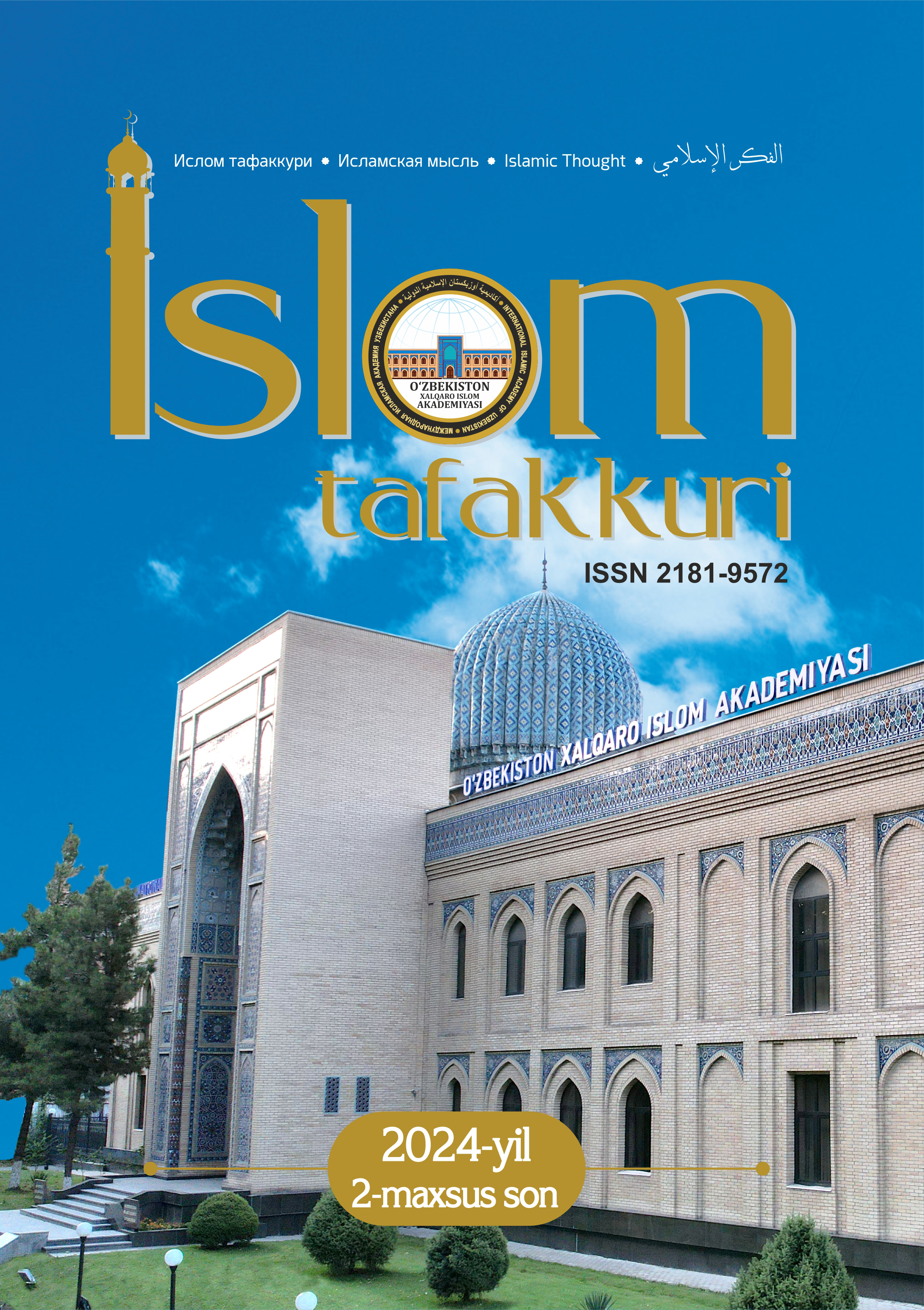
Vol. 7 No. Special Issue 2 (2024)
Articles
SOLVING SOCIAL PROBLEMS IN THE WORK OF “AL-MUSTASFА”
The article talks about social problems in the work of the Hanafi scholar Imam Hafizuddin Abul Barakat Nasafi. The work highlights the sections “Marriage”, “Divorce”, “Рrovision” and describes the problems associated with it today. In addition, the work “al-Mustafa” provides solutions to problems that arise in family life.
PROFESSOR SHARI'I JUZJANI
The article highlights memories of the first meeting with the prominent political and statesman, Islamic and Sufi scholar Abdulhakim Shar'iy Jauzjani in Afghanistan in 1972. The text provides brief information about the scholar's career in publishing houses under the Ministry of Culture and Information after graduating from the Faculty of Sharia at Kabul University, particularly his work as the head of the Folklore Department.
Contracts in Islamic economics: content and principles
This article highlights the importance of goals and meanings in contracts and their impact on the final outcome of contracts. In what cases it is used and the sources of origin of this rule are analyzed. Types of transactions are classified according to their purpose. In the conclusion, the power and importance of each word in the deals and the consequences of their influence are mentioned
THE SIGNIFICANCE OF ECONOMIC AFFAIRS IN ISLAMIC CIVILIZATION
This article delves into the intricate financial structures and institutions that underpin the economic framework of Islamic civilization. From the foundational principles to the contemporary manifestations, we explore the evolution of economic systems within the Organization of Islamic Cooperation (OIC) and the pivotal role played by institutions such as the Islamic Development Bank (IDB) in fostering economic growth and development across Muslim-majority nations.
KHILVAT AS A PSYCHOLOGICAL METHOD OF INVOKING MYSTICAL STATES
This article is devoted to the issue of khilwat, which is one of the important elements of the teaching and practice of Sufism. It is known that Khilvat is one of the psychological methods of creating mystical states. The article presents the psychological advantages and disadvantages of khilvat. One of the tasks of Khilvat is to induce states that arise as a result of closeness to God - fana and baqa. Every Salik is required to establish a dialectical interaction between the physical and spiritual Khilvat.
NEGATIVE INFLUENCE OF DESTRUCTIVE SECTS ON THE SPIRITUAL DEVELOPMENT OF YOUTH
The article analyses the concept of a sect, reveals the characteristics of destructive sects and discusses the impact of such sects on the spiritual development of young people. It defines the concept of destructive sects and emphasizes the negative impact of such sects on people's lives and society. It also emphasizes that destructive sects in their missionary activities pay great attention to young people whose consciousness is not yet sufficiently developed and who have no life experience, and who seek to become spiritually dependent by capturing their mind, outlook and heart. It is said that involving young people in such sects can lead not only to their spiritual impoverishment, but also to the decline of national spirituality and irreparable social crises.
ANALYSIS OF THE HISTORY AND EVOLUTION OF METHODS FOR LIBERATING INDIVIDUALS FROM THE INFLUENCE OF DESTRUCTIVE CULTS
This article analyzes the history and evolution of methods for freeing individuals from the influence of destructive cults. Various approaches and strategies applied over time, from early intervention attempts to modern methods such as Steven Hassan's strategic interaction approach, are examined. Changes in approaches to combating cults and the adaptation of these methods to new challenges and conditions are assessed.
STRATEGIC DIRECTIONS OF DEVELOPMENT OF COOPERATION OF CHINA AND UZBEKISTAN IN THE FIELD OF TRANSPORT
This article analyzes the strategic directions of the development of cooperation in the field of transport between the People’s Republic of China and the Republic of Uzbekistan. Exchange of scientific innovations between China and Uzbekistan in road construction, infrastructure formation, introduction and approval of modern low-cost technologies, engineering and design, and scientists, young researchers and researchers engaged in this field. sending researchers, master’s and bachelor’s students who are studying with exemplary and excellent grades from Uzbekistan to relevant scientific research institutes and mature companies of China for training, and correspondingly attracting mature Chinese scientists to our country and organizing international conferences, conducting seminar trainings It is clear that the creation and implementation of conditions for increasing or interactive dialogues and active implementation of other activities and learning of their experiences will contribute to the further development of the transport sector and its modernization.
PRIORITY DIRECTIONS AND PROBLEMS OF MODERN INTERNATIONAL POLITICAL RELATIONS
this article focuses on the modern political space, the environment in which political processes, ideas, interests are formed and implemented, the space of interaction between political forces, society and the state, the demands of the time and the main problems in it. The article also analyzes the priorities of globalization and international relations, political instability and conflicts, transformation and cybersecurity, the growth of political extremism and populism, the growth of economic inequality and social tension, which reflect the modern political space.
A GOOD VIRTUE THAT BECAME A VALUE
The article is devoted to generosity which is considered as the part of national identity of Uzbeks. The author believes that it became as national character of Uzbeks because they were brought up almost 10 centuries according to didactic literature which was watered with generosity, hospitality philanthropy.
RELIGIOUS AND NATIONAL TOLERANCE OF THE JADIDS
This article analyzes the activities of representatives of the national progressive movement - the Jadid movement, which arose in Central Asia in the late 19th - early 20th centuries, whose efforts were aimed at the spiritual reform of society, solving current problems on the basis of universal and national values, as well as promoting religious and national tolerance among compatriots.
ТHE EXPLANATION OF TAKFIR (EXCOMMUNICATION) AND BAG’I (INSURGENCY) ISSUES IN THE WORKS OF IMAM MATURIDI
One of the relevant topics of today, undoubtedly, is the issue of “takfir”. This is because, at present, there is an increase in the excommunication of Muslims by many extremist factions, meaning that cases of labeling someone as a disbeliever even in matters where disbelief cannot be considered are being observed. If such a situation arises, it is considered insurgency according to Maturidism. Therefore, studying the works of Imam Maturidi to refute these issues and effectively use them against extremism holds great importance.
THE ROLE OF ISLAM IN THE DEVELOPMENT OF SOCIAL AND CULTURAL LIFE IN MOVARUNAHR
In the 9th century, great positive changes took place in the culture and spiritual life of Maverannahr, which left an indelible mark on the history of not only Central Asia, but also the entire Muslim East. Islam has replaced old religions in spiritual life. Maverannahr, which has an ancient and rich culture, began to play an active role in the socio-economic and cultural life of the Arab Caliphate.
THE ROLE OF ORAL TRADITION IN THE FORMATION GENRE MANAQIB
This article examines the role of oral tradition in the formation of the manaqib genre. It considers how oral legends, legends and tales about Prophet Muhammad (p.b.u.h) and his companions have influenced the development of this literary form. The distinctive characteristics of oral folk art, reflected in manaqibs, are analysed. It can be concluded that oral tradition played a pivotal role in the genesis of the manaqib genre, influencing its themes, style and poetic techniques.
ROLE OF WAQF PROPERTIES IN THE HISTORY OF TURKESTAN
The article is devoted to the analysis of historical documents concerning waqfs, peculiarities of waqfs, as well as statistical data concerning Islamic architectural monuments of waqfs. In conclusion, it was concluded that many mosques and madrassahs were built and existed on the basis of wakf donations thanks to the generosity of representatives of our people.
THE ROLE OF FAMILY AND MARRIAGE RELATIONS IN ENSURING SOCIETY STABILITY
The article examines family and marriage relations, which is an important link in the development of society and it seems that family and marriage relations remain one of the pressing social problems. In the social life of Eastern countries, based on the Uzbek mentality, family relationships are considered a very important factor, which can be the envy of the whole world, and special attention is paid to the issue of the religious and philosophical essence of the family. The article provides as an example the family system, which can serve as an example in the field of spiritual formation in Uzbekistan, its internal factor in the socio-political, cultural and spiritual life of society, first of all, comments on the coverage of family relationships in Islamic religious sources are given as an example. After all, the strength of society depends on strong family and marriage relationships. The article also reflects that the strength of the family, which occupies an important place in the foundation of scientific and religious knowledge in the field of family relationships, remains an important factor in ensuring stability, peace and tranquility of society.
PHILOSOPHICAL ANALYSIS OF HUMAN CONCEPTION IN BAHOUDDIN NAQSHBAND'S RUBAIS
The article highlights the essence of Bahauddin Naqshband's concept of man based on the philosophical analysis of the phrase "None" in the works of "Maqamoti Khoja Bahauddin Naqshband" and "Rubaiyoti Khoja Naqshband", the main sources of Naqshbandi teachings. Although man is outwardly a small universe, inwardly he is a universe as big as the Universe and a encompassing being that embodies the whole being, and its eternal and mortal sides are explained.
PRONOUNS AND THEIR PLACE IN ARABIC GRAMMAR
In Arabic, the pronoun belongs to the group of nouns and is divided into the types damir munfasila, ismi ishara, damir fasl, damir muttasila, damir a'aid, ismi mawsula, ismi istifhom.
PLACE OF PUNCTUATION IN THE PERSIAN LANGUAGE
Punctuation marks are elements that play an auxiliary role in the language writing system. Most languages have punctuation marks in their writing system, which perform almost the same function. In fact, syntactically formed punctuation marks make it easier to perceive and understand the text, in particular, to form intonation (especially to distinguish semantic pauses and logical emphasis) when reading aloud. Commas are widely used punctuation marks in persian language. There are some specific features in the use of this sign. In this article, some changes of these features of the Persian language comma in recent years have been considered.
STRATEGIES FOR MASTERING THE CATEGORY OF COMPARISON IN SPEECH ONTOGENESIS
The article discusses and analyzes some strategies for children to master comparisons in the Russian language. Illustrative material consists of more than 10 years of observations of the speech of Russian-speaking children and bilinguals (Uzbek and Russian), as well as parental diaries of observations of the speech of children from 0 to 15 years. Comparison in children's speech is not only a systemic element of language, but also a phenomenon that indicates the development of the child’s cognitive abilities and his linguistic picture of the world, and his mastery of metaphorical meanings. Comparison is one of the first signs of beginning to master metaphor. To identify strategies for mastering the category of comparison, the author analyzed about 900 linguistic units with the meaning of comparison from the speech of children, and the subjective meaning invested by the child was also clarified.
SOURCE STUDY OF THE WORK “TARIHI GARDIZI”
This article is devoted to the source study of the work “Tarihi Gardizi” by one of the famous representatives of Islamic science of the 11th century, historian, geographer Abu Said Abdulhay ibn Zahhok ibn Mahmud Gardizi. This work is one of the valuable sources written about the pre-Islamic period and the history of Islam. The work contains a lot of unique information about famous people of the Islamic world, the activities of rulers, socio-political events, and in the article this information is disclosed in a comparative form.
REFORM OF MODERN DRAMA IN CHINESE LITERATURE (SECOND HALF OF THE TWENTIETH CENTURY)
This article talks about the reforms of the dramatic genre in Chinese literature in the second half of the 20th century. In addition, the article talks about formation factors that are fundamentally different from previous forms of the genre of the early 20th century. By the 80-90s of the second half of the 20th century, new interpretations of the genre, works created by playwrights, the theory of Western drama, issues of influence, and places of translation were outlined.
PROBLEMS OF COMPETENCE OF AN ARABIC LANGUAGE TEACHER
This article discusses the concepts of competence and competence in pedagogy, the stages of their implementation in the education system. The objective and subjective factors that determine the need to learn Arabic are analyzed. Special attention is paid to the use of modern educational technologies to achieve learning outcomes and adapt it to the requirements of the labor market. The importance of providing the knowledge and skills necessary for the work of any professional, as well as the dissemination of the Arabic language and the computerization of its training, is emphasized.
MANUSCRIPTS OF THE BOOK OF ABU HAFSASAFI “KITABU-L-KAND”
This article provides detailed information about the book of the medieval encyclopedist Abu Hafs Nasafi “Kitabu-l-qand” and his manuscripts, which are considered to be from rare handwritten sources. The article talks about which libraries in the world and in what condition the manuscripts of this book and its contents are stored.
MIR ABD AL-KARIM BUKHARI AND HIS WORK ON THE HISTORY OF CENTRAL ASIA
The article is devoted to the traveler, historian and diplomat Mir Abd al-Karim bin Mir Ismail Bukhari, lived in 19th century, and to his work on the history of Central Asia written in Persian. The study provides information about the life and activities of the author, as well as the study emphasizes the scientific significance of the book in the study of the history and geography of the region.