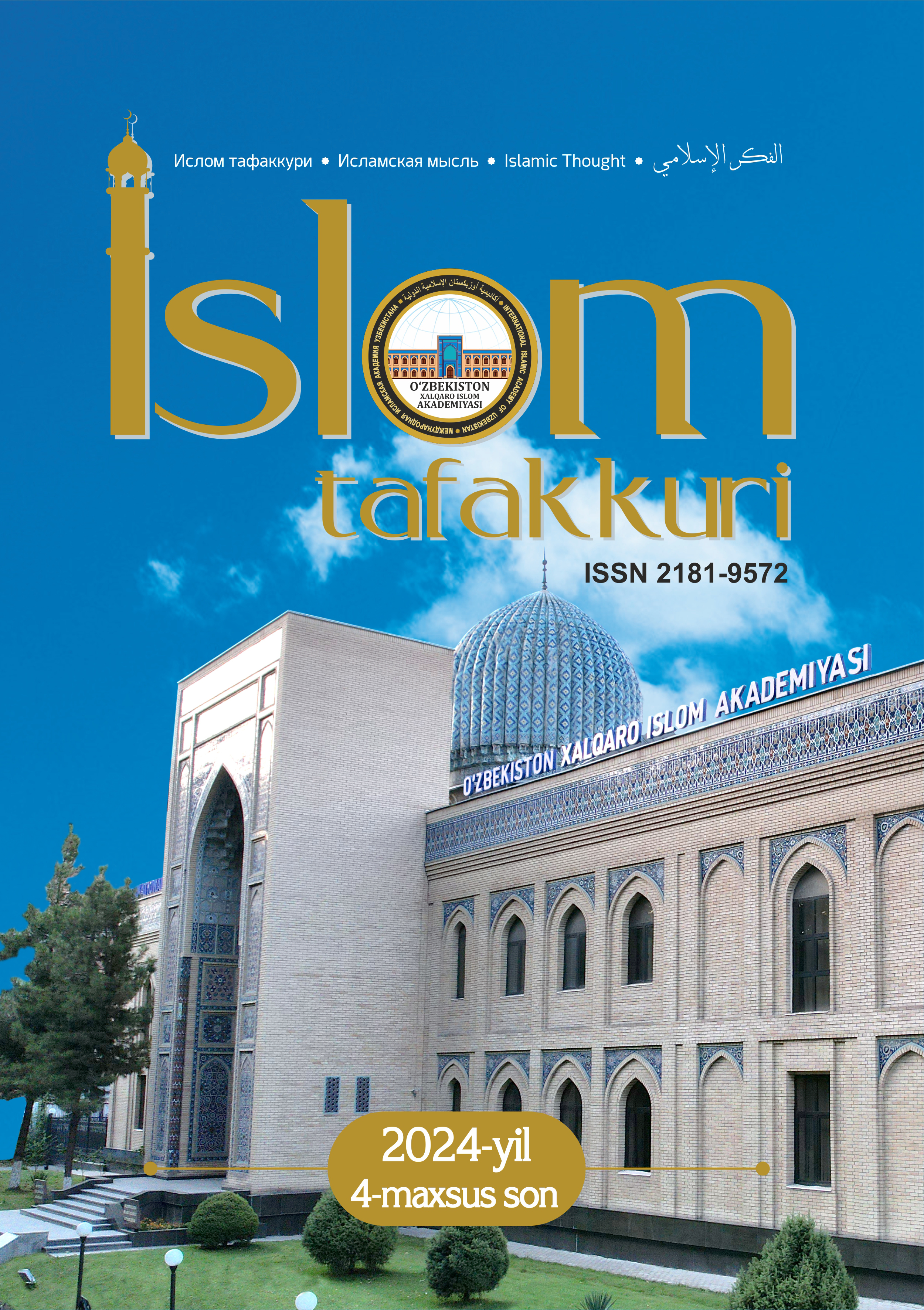
Vol. 8 No. Special Issue 4 (2025)
Articles
ACHIEVEMENTS IN THE FIELDS OF EDUCATION, SCIENCE, AND INNOVATION
The 80th session of the United Nations General Assembly was held in New York on September 22, 2025. During the session, the President of the Republic of Uzbekistan, Shavkat Mirziyoyev, delivered a speech. In his address, he highlighted the reforms being carried out to build a democratic, legal, social, and secular New Uzbekistan. In particular, he emphasized the progress achieved in the fields of education, science, and innovation.
QUALITY EDUCATION IS THE BASIS FOR SOCIAL DEVELOPMENT
Experience in developed countries demonstrates that, alongside material resources, spiritual factors also play a significant role in societal development. Among these factors, the role of educational institutions is particularly significant. With highly qualified educational specialists, government policies aimed at enhancing their social status will contribute to the sustainable development of society. This research article examines the current status and development prospects of educational institutions in Uzbekistan. Based on an analysis of recent events and facts, the article reveals challenges in the field of education.
STRENGTHENING THE ROLE OF WOMEN IN SOCIO-POLITICAL LIFE AS A PRIORITY OF THE NEW UZBEKISTAN
The article examines gender policy as one of the key priorities of the New Uzbekistan's development strategy. It analyzes initiatives aimed at strengthening the role of women in socio-political and business spheres, announced at the 80th session of the UN General Assembly. Special attention is paid to the proposal to transform the Asian Women's Forum into a permanent regional platform for cooperation.
THE ROLE OF WOMEN IN LARGE-SCALE REFORMS IN UZBEKISTAN
Today, a comprehensive study of the social, cultural, and spiritual aspects, as well as the socioeconomic, legal, educational, and organizational aspects of women's issues in our country, is one of the most pressing issues. This issue is particularly relevant because, first and foremost, at the current stage of our society's development, it is socially imperative to conduct a scientific analysis of legal norms regarding women's issues in the process of raising the spirituality of the Uzbek people, including legal literacy. Secondly, by analyzing and studying the fundamental principles of legal norms, it is necessary to correctly apply this knowledge to improving the role of women in the family and society, which is highly relevant today.
In this regard, this article analyzes the spiritual, legal, and educational factors of women's rights, set out in the regulatory acts adopted in the Republic of Uzbekistan, based on the speech of the head of our state at the 80th session of the General Assembly of the United Nations.
EDUCATION AT THE UN TRIBUNE: PRIORITY DIRECTIONS OF EDUCATIONAL POLICY IN NEW UZBEKISTAN
This article presents analytical materials about the current educational reforms being carried out in New Uzbekistan, state policy, and the attention given to Uzbekistan’s human capital at the international level. Special focus is placed on the speech delivered by President Shavkat Mirziyoyev at the UN General Assembly on September 23, 2025, in which he expressed the country’s position before the international community regarding the achievements in unlocking youth potential within the context of the “New Uzbekistan” strategy.
UZBEKISTAN'S EVOLUTIONARY POLICY IN RELATION TO AFGHANISTAN
This article explores the rationale behind the Republic of Uzbekistan's recent policy toward resolving the Afghan problem and the role of its measures aimed at ensuring stability and peace in Central and South Asia by normalizing the situation in that country. Particular attention is paid to the creative and rational role of the Head of State of Uzbekistan in this large-scale effort.
INITIATIVES OF UZBEKISTAN TO COMBAT CLIMATE CHANGE AND ENSURE ENVIRONMENTAL SUSTAINABILITY
The article analyzes the global environmental situation in 2025, focusing on the impacts of climate change on Central Asia and Uzbekistan. It highlights President Shavkat Mirziyoyev’s initiatives, the transition to a green economy, and regional cooperation. Special attention is given to the Aral Sea crisis, water resources, and sustainable development issues.
COUNTER-TERRORISM ACTIVITY AND REHABILITATION CENTERS OF UZBEKISTAN
This article analyzes contemporary mechanisms for combating terrorism at international and regional levels, with a particular focus on the UN Global Counter-Terrorism Strategy (2006) and its implementation in Central Asian states. The strategy encompasses key areas such as addressing the root causes of radicalization, enhancing international cooperation, cutting financial sources of terrorism, and supporting victims of terrorist acts. The study highlights the role of international institutions such as Interpol, Europol, NATO, the European Union, and the Shanghai Cooperation Organization in forming a unified counter-terrorism system.
UN-80: NEW UZBEKISTAN, RENEWED CENTRAL ASIA, AND COMPREHENSIVE APPROACHES TO GLOBAL CHALLENGES
This article analyzes Uzbekistan's initiatives put forward within the UN framework in recent years, particularly its efforts aimed at strengthening regional cooperation in Central Asia. Furthermore, it demonstrates the degree of congruence between Uzbekistan's comprehensive approach to transforming Central Asia into a space of peace, stability, and sustainable development and the UN's global objectives (Sustainable Development Goals, peacekeeping).
THE LEGACY OF GREAT ANCESTORS AS THE FOUNDATION OF THE UNIVERSAL HUMANITARIAN DOCTRINE
In the contemporary era of globalisation, the cultivation of mutual understanding between diverse cultures and civilisations, in addition to the countering of the vices of extremism and fanaticism, has become increasingly paramount. The scientific and spiritual legacy of Uzbekistan's great ancestors – Imam al-Bukhari, Imam al-Tirmidhi, and Imam al-Maturidi – serves, in such complex circumstances, as a universal programme of humanism and tolerance. The present article is dedicated to the analysis of the essence of these scholars' heritage, the goal behind its presentation at the United Nations (UN) and its role as a solution to contemporary global problems.
THE TRANSFORMATIONAL MODEL OF LEADERSHIP IN THE NEW UZBEKISTAN STRATEGY: A PSYCHOLOGICAL ANALYSIS OF THE PRESIDENT’S SPEECH
This article analyzes the model of transformational leadership within the “New Uzbekistan” strategy through the example of President Shavkat Mirziyoyev’s speech at the 80th Session of the UN General Assembly. The study explores the psychological and communicative dimensions of the speech that demonstrate the leader’s role as a driver of modernization and sustainable development. Based on transformational leadership theories (J. Burns, B. Bass), the paper identifies the psychological mechanisms underlying effective governance and leadership transformation in Uzbekistan.
KEY PRINCIPLE OF UZBEKISTAN'S FOREIGN POLICY: OPEN DIALOGUE AND CONSTRUCTIVE COOPERATION
This article analyzes the priority directions of the foreign policy of New Uzbekistan. It examines the strategy for strengthening regional and global ties, based on the principles of openness, mutual understanding, and constructive partnership put forward by President Shavkat Mirziyoyev. The article demonstrates Uzbekistan's firm commitment to developing international cooperation.
PROSPECTS FOR REGIONAL COOPERATION AND INTEGRATION IN THE NEW CENTRAL ASIA
This article examines the new stage of regional cooperation and integration in Central Asia. It highlights the role of initiatives put forward by President Shavkat Mirziyoyev of Uzbekistan, which have led to the institutionalization of political dialogue, expansion of economic cooperation, establishment of joint mechanisms in water and energy management, as well as enhanced security and cultural-humanitarian integration. The study emphasizes the strategic significance of such cooperation for sustainable development of the region, its position in the international system, and future prospects.
THE FAMILY AS A STRATEGIC RESOURCE OF THE STATE: EVOLUTION OF THE LEGAL STATUS OF THE INSTITUTION OF THE FAMILY IN THE CONTEXT OF THE SOCIAL REFORMS OF THE “NEW UZBEKISTAN”
The article analyzes the institution of the family as a strategic resource of the state and a foundation for sustainable social development in the context of the social reforms of the “New Uzbekistan” era. Particular attention is given to the ideas expressed by the President of the Republic of Uzbekistan, Shavkat Mirziyoyev, in his address to the 80th session of the United Nations General Assembly, where the family was defined as a key priority of state policy. The article reveals the interrelation between national legislation, traditional values, and international standards for the protection of the family, as well as presents statistical data reflecting current trends in marriage and family relations. It concludes that the consistent improvement of family legislation contributes to strengthening the legal, moral, and spiritual foundations of society in accordance with the concept of the “New Uzbekistan”
POVERTY REDUCTION AND SUSTAINABLE DEVELOPMENT IN UZBEKISTAN
Based on the speech by the President of the Republic of Uzbekistan Shavkat Mirziyoyev at the 80th session of the UN General Assembly, this article analyzes the interconnected model of poverty reduction and achieving sustainable development in the country. Through the specific statistical data and strategic directions presented in the speech, Uzbekistan's achievements and future goals in this area are revealed. The article highlights the role of education, innovation, «green» energy, and small business as the main drivers of socio-economic development.
UZBEKISTAN-2030 STRATEGY: A COMPREHENSIVE APPROACH TO SOCIO-ECONOMIC TRANSFORMATION
The article examines the comprehensive strategy of socio-economic transformations in modern Uzbekistan, implemented within the “Uzbekistan-2030” program. It analyzes four key areas of reform: targeted poverty reduction through the unique “mahallabay” system, investment in human capital through the modernization of education, a decisive transition to a “green” economy with an emphasis on renewable energy sources, and comprehensive support for small and medium-sized businesses. The author highlights the synergistic effect of these measures, where social policy, educational development, energy transformation, and entrepreneurial activity are interconnected and aimed at achieving sustainable development and improving the well-being of citizens.
EDUCATION IS THE KEY TO PEACE AND PROGRESS
This article highlights the speech delivered by the President of the Republic of Uzbekistan, Shavkat Mirziyoyev, at the 80th anniversary session of the United Nations General Assembly, as well as the role of enlightenment in human life and the development of society. Special attention is given to the importance of educating the younger generation to become knowledgeable and spiritually rich individuals who ensure the sustainable development and prosperous future of the country.
THE UNITED NATIONS AND UZBEKISTAN: DIGITAL TRANSFORMATION AND NEW PROSPECTS IN THE FIELD OF EDUCATION
The article analyzes the role and significance of the United Nations (UN) within the system of international relations, as well as the directions of cooperation between the Republic of Uzbekistan and this organization. It also examines the processes of digital transformation and innovative reforms in the field of education in Uzbekistan within the framework of the UN Sustainable Development Goals. The study highlights Uzbekistan’s international initiatives, the implementation of modern information technologies in public administration, and the issues of ensuring sustainable development through the digitalization of the education system.
ANALYSIS OF THE EVOLUTION OF STRATEGIC PLANNING IN THE REPUBLIC OF UZBEKISTAN (1991–2023)
This study presents a retrospective trend-oriented analysis of the experience of developing national and regional development strategies in the Republic of Uzbekistan. The analysis covers the period after independence in 1991, characterised by a complex transition from a planned economy to market-oriented strategising. The focus is on the development of a long-term national strategy (first substantiated in 2016–2017) and the evolution of territorial strategic development practices. The main conclusion is that effective management of socio-economic development is ensured by the correlation of national and regional strategies based on unified methodological approaches, as well as the integration of innovative technologies as a key driver of structural transformations.
UZBEKISTAN’S PATH TO PEACE: INITIATIVES TO ENHANCE THE ARCHITECTURE OF GLOBAL SECURITY WITHIN THE UN SYSTEM
This article analyzes the significance of international cooperation mechanisms in addressing the global challenges of the 21st century – such as climate change, nuclear threats, terrorism, cybersecurity, and pandemics. Within the framework of the 80th session of the United Nations, particular attention was paid to improving the architecture of global security, reforming the UN system, and strengthening multilateral diplomatic dialogue. The article provides a scholarly analysis of the key initiatives proposed by the President of the Republic of Uzbekistan, Shavkat Mirziyoyev, in his address to the UN General Assembly – namely, the modernization of the UN Security Council, the transformation of the Regional Council on Counter-Terrorism and Reintegration into an international competence center, and the establishment of a regional counter-terrorism body in Uzbekistan.
THE POLICY OF BUILDING A DEMOCRATIC, LEGAL, AND SECULAR STATE OF THE REPUBLIC OF UZBEKISTAN
This article comprehensively covers the theoretical foundations, practical mechanisms, and legal aspects of the policy of building a democratic, legal, and secular state in the Republic of Uzbekistan. President Shavkat Mirziyoyev's speech at the 80th session of the UN General Assembly will be analyzed and considered in accordance with the norms of national legislation. Scientific opinions on the relevance, problems, and prospects of the topic are also put forward.
MANIFESTATION OF UZBEKISTAN’S POLICY OF TOLERANCE AT THE INTERNATIONAL LEVEL
This article analyzes the strategic demonstration of the Republic of Uzbekistan’s policy of tolerance at the international level, drawing on the address of President Shavkat Mirziyoyev at the UN General Assembly. The strengthening of regional peace in Central Asia, the fight against global ecological threats, and the development of dialogue among peoples, cultures, and civilizations are integral continuations of Uzbekistan's position on tolerance, fundamentally based on the principle of “Enlightenment against Ignorance”. The country’s priority directions are examined, including specific proposals for educating youth in the spirit of peace and deepening international cooperation