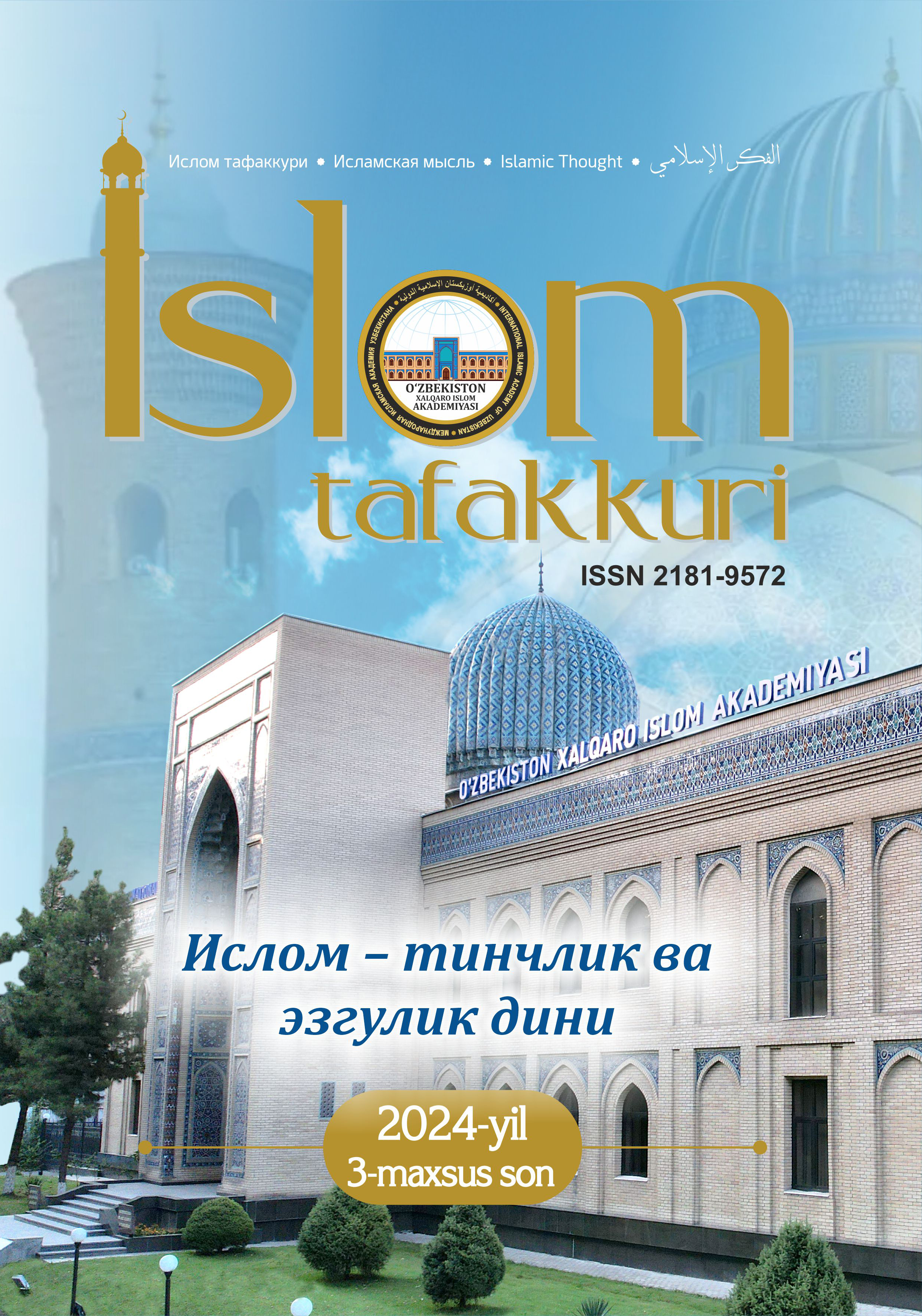
Vol. 7 No. Special Issue 3/2 (2024)
Articles
ROLE OF “THE SUN OF TWO WORLD” IN UPBRINGING OF YOUTHS
Sultan Uvais Qarani was famous as “the Sun of the two World”, “the Star of Yemen”, “Distinguished one of Tabiuns”. Also he was distinguished and great tabiun who was famous for his good qualities.He was an ordinary and modest man and his spiritual life differed from others. Also, he was a perfect man with strong spirituality and will power. Uvais Qarani states that silver and gold had no price for those who had known Allah. He also said that it was necessary to call people for good things and to prevent them from bad things and to say the truth in spite of any difficulties.
JERUSALEM IS ISLAM’S SYMBOL OF PEACE
Being one of the most widespread religions in the world, Islam has proven itself as a religion of peace and goodness over the centuries due to its tolerant and peaceful approach to various political and social situations. History has not forgotten the tolerance and peaceful policy shown by Muslims towards non-Muslims during the Treaty of Hudaybiyyah, the conquest of Mecca, and the conquest of Jerusalem by Caliph Umar and Salahuddin Ayyubi. Especially when the city of Jerusalem was first conquered by the Muslims in 638, the promise of peace given by the Caliph Umar regarding non-interference in the lives and religions of the unbelievers is a clear expression of the fact that Islam is a religion of goodness.
FEATURES OF SHIITE COMMUNITIES IN UZBEKISTAN (From the history of the Samarkand and Bukhara “Irani”)
The history of the Shia communities living today in Central Asia, along with other small religious communities, i.e. their penetration into Central Asia, their formation as a community, their way of life, their place in our history, customs, traditions, beliefs is still not studied deeply and systematically from the point of view of historiography, Islamic studies, ethnography and culture of Uzbekistan. The article is devoted to an overview of the history and culture of Shiite communities represented by the “Ironi” ethnic group living in Uzbekistan. Because the Shiite communities have played a significant role in the political, socio-cultural life of Central Asia for centuries and are inextricably linked with other religious communities living in the region.
PECULIARITIES OF THE SEMANTIC FIELD OF THE LEXEME “ISLAM”
The semantic analysis of the different shades of meaning of the lexeme “Islam” in the Qur’an, which is the main source of the Islamic religion, is important for determining the origin, development and place of this concept in Islamic doctrine. This article is devoted to the study of the semantic peculiarities of the lexeme “Islam”, which gave its name to the last religion. Based on the diachronic semantic method, the root slm and its derivatives used in different contexts, as well as their shades of meaning, have been analyzed.
PHILOSOPHICAL ANALYSIS OF THE CONCEPT OF PIRI-MURSHID IN THE TEACHINGS OF YAQUB CHARKHI
This article presents information from Yakub Charkhi’s treatise “Risalai unsiya” about the conversations of Sufi spiritual masters and the teacher-student relationship. The author’s goal in writing this treatise was to shed light on the customs and practices of the tariqa and the life path of his teacher Alauddin Attar for the murids of Bahauddin Naqshband. While Bahauddin Naqshband was Charkhi’s mentor in teaching the science of dhikr, the role of Alauddin Attar in the development of the tariqa is also very significant.
ELUCIDATION OF THE ISSUE OF PEACE IN THE MAIN SOURCES OF ISLAM
The article discusses the statements about peace and harmony in the Quran and Hadith, which are the main sources of Islam, and argues that the main purpose is to call for peace and justice, which is considered important for all mankind, and to be free from vices such as anger, hatred, enmity, corruption and cruelty. Peace is the essence and necessity of both life and Islam. Peace is the greatest blessing that God has given to all mankind. Islam has made the concept of peace its main idea and an important motto, and it is argued that people should act in solidarity and solidarity and put an end to mutual enmity in order to maintain peace and ensure stability.
ISLAM IS A RELIGION OF BENEVOLENCE AND HARMONY
Islam is one of the most widespread religions in human history, founded on the values of goodness, peace, equality, justice, and charity. According to the teachings of this sacred religion, people should treat each other with kindness, compassion, and respect. The Islamic religion defines the way of life for Muslims, shaping their beliefs, morality, and socio-economic relations.
THE ESSENCE OF GOODNESS OF ISLAM: THE ISSUE OF PEACE IN THE QUR’AN AND THE SUNNAH
This article explores the inherently peaceful and tolerant nature of Islam, emphasizing the Quran and Sunnah’s teachings on unity. It challenges misconceptions that associate Islam with violence, specifically addressing the negative consequences of misinterpreting the concept of jihad. Furthermore, the article examines how Islam promotes harmony among people of different nationalities and religions, highlighting the significance of the “Constitution of Medina” in fostering peaceful coexistence.
FEATURES OF THE LIFE AND SCIENTIFIC ACTIVITY OF AHMAD BALADHURI
The article, based on medieval sources, examines information about the life, teachers and scientific work of the historian and poet Ahmad ibn Yahya al-Balazuri, who lived in the 9th century. In the article, historians who gave information about the life of Ahmad ibn Yahya al-Baladhuri, their works, Ahmad al-Baladhuri’s work in Baghdad information about his activities, teachers and students, the historian’s trip to Damascus to study, his teachers there, and then his return to Baghdad, and his work as a nadim in the caliph’s palace. There is also information about al-Baladhuri’s scientific activity, his works such as “Futuh al-buldon”, “Ansab al-ashraf”, “Ahdu Ardasher”.
ARTISTIC INTERPRETATION OF HUMANISTIC IDEAS IN UZBEK CLASSICAL LITERATURE
The article explores the interpretation of ideas such as goodness, purity, humanity, and creativity within Uzbek classical literature, analyzed through the use of images and symbols in artistic works. It includes excerpts from the lyrical heritage of poets like Yusuf Khos Hajib, Ahmad Yassawi, Alisher Navoi, Sofi Olloyor, and Boborahim Mashrab. Furthermore, the paper reveals how these classical artists’ literary legacies artistically interpret Islamic ideas in alignment with mystical concepts and figurative imagery, through detailed analyses and generalizations.
THE PRINCIPLE OF RELIGIOUS TOLERANCE OF MUHAMMAD SHAHRISTANI
This article examines the approach to religions in the work “al-Milal wa-n-nihal,” authored by the renowned scholar Muhammad ibn Abdulkarim Shahristani from the 11th-12th centuries. In his study, he conducted an objective analysis of various religions. Today, his tolerant perspective towards religions provides a foundation for structuring interreligious dialogue effectively.
HISTORICAL FOUNDATIONS OF KALAM
When was the first work on Islamic theology (kalam) written? What names has kalam been known by since its emergence? What were the causes of the theological debates among Muslims? When did discussions on kalam based on the Quran and Sunnah begin? This article explores these questions.
COMMENTARIES WRITTEN ON THE WORK “SHAMAIL AL-MUHAMMADIYA” AND THEIR FEATURES
This article presents a scientific analysis of the work “Shamail al-Muhammadiya” Imam Tirmidhi. The article talks about the various interpretations of the work “Shamail al-Muhammadiya”. Detailed information will be given about the commentaries written on the work and their features.
ISLAMIC CONCEPT OF PEACE: THEORETICAL FOUNDATIONS AND SIGNIFICANCE
This article examines the concept of peace in Islam, highlighting its significance as a divine blessing from Allah. This understanding underscores the high value placed on peace within the Islamic tradition, obligating every Muslim to cherish and safeguard it. The article presents a comparative analysis of the concept of peace, drawing on both religious and contemporary sources. It explores the perspectives of prominent figures in the Muslim world, providing insights into their understanding and contributions to the discourse on peace.
QUESTIONS OF VIRTUE IN THE RASHḤAS OF BAHĀʾ-AL-DĪN NAQŠBAND
The article philosophically analyzes the path and principles of the sect founded by Bahauddin Naqshband, a major manifestation of Sufism, taken from Fakhruddin Ali Safi’s «Rashohotu ainil-hayat». Islam is considered to be a religion of goodness, and all mystics have a special approach to this topic in their essays. The real meaning of rashhas is to always keep one’s ego pure, to be alert and intelligent at all times.
CONTRIBUTION OF SAHIBQIRAN AMIR TEMUR AND SHAKHRUKH MIRZA TO THE DEVELOPMENT OF SCIENCE
The Timurid era witnessed a flourishing of various sciences. Amir Timur, eager to foster intellectual growth, invited scholars to Samarkand and established madrasas for their instruction. Following Timur’s death, Shahrukh, who moved the capital to Herat, continued this patronage of learning, treating scientists and artisans with the same respect as his father and attracting scholars from across the region. This article examines Amir Timur and Shahrukh Mirza’s dedication to the advancement of knowledge. Drawing upon historical evidence, including accounts by contemporary Arab and Persian historians, it explores Sahibqiran Amir Timur’s engagement in scholarly debates and highlights his intellectual acumen.
ISLAM IS A RELIGION OF GOODNESS AND PEACE
This article explores the role of Islam in the modern world, focusing on the challenges and opportunities it faces within the context of globalization. It examines how Islam, like other major religions, is navigating the complexities of an interconnected world, both within Muslim-majority countries and globally. The article aims to analyze the study of Islam, its rich cultural values, and its influence on global affairs. It seeks to understand how Islam interacts with contemporary issues and contributes to shaping the world we live in. Finally, the article concludes by highlighting the key findings of this exploration and emphasizing the ongoing relevance of understanding Islam’s place in the modern world.
WOOD ART
This article is a unique artwork of the Bukhara school of wood carving, located in the exhibition and storage facilities of the Bukhara State Museum-Reserve - panels for decorating the wall, double-leaf doors and gates in the style of «Baghdadi» and «Ubaidi,» a hadith written in the gates of the Ulugbek madrasah, a wooden tombstone of Saifiddin Boharziy, about bamboo branches on which the verses of the Qur’an are written.
THE HISTORY OF HUSAINIAKHANA OF BUKHARA
The main religious rituals of the Bukharian Iranians are performed in special rooms (khona) - husainiyahs. The article is devoted to the architecture and history of the oldest Shia mosque and husainiyah-khona preserved in Bukhara. The fact that the existing architecture of husainiyah in Bukhara is a topic that has not previously been subjected to scientific research increases the relevance of the work.
TALKING STORIES IN THE HOLY QURAN
This article contains information about repetitions in the Qur’an, repetitions in Qur’anic stories and their specific aspects, and reflects several analyses of the author related to the topic. The author refers to the stories of prophets Adam (pbuh), Moses (pbuh) and others when analyzing the repetitions in the stories of the Qur’ان. As a result, it laid the foundation for the formation of reliable and objective information in the student.
PRINCIPLES OF INTERRELIGIOUS DIALOGUE AND RELIGIOUS TOLERANCE
The concept of interfaith dialogue is necessary for the entire discipline of socio-cultural cooperation. Recently, interest in this topic has been renewed. The need for interfaith dialogue implies the idea of tolerance between the participants of the process and occupies one of the leading positions in the field of socio-cultural cooperation. There is a lot of evidence in this article that communication and tolerant relations are a necessary condition for solving the problems of the 21st century.
USE OF EXPERIENCE AND EDUCATION METHODS OF THE ELDERLY IN ISLAM
This article examines the esteemed position of the elderly in Islam. It explores the profound respect accorded to elders, emphasizing the value of their rich life experiences, wisdom, and guidance. The article analyzes how these principles are reflected in Islamic traditions, emphasizing the role of elders in transmitting values, upholding cultural heritage, and nurturing younger generations.
LIFE IS PEACE AND CALM
This article offers a philosophical analysis of vitality, peace, and tranquility as central concepts in Khoja Yusuf Hamadani’s “Rutbat ul-hayat” (“Criterion of Life”). Hamadani’s work contrasts two perspectives on the meaning of life: one that prioritizes material wealth and another that emphasizes spiritual fulfillment. Through a comparison of these perspectives, the article explores the themes of self-control and the cultivation of a virtuous character.
ROLE OF HAZRAT IMAM KAFFAL SHASHI IN ENSURING PEACEFUL RELATIONS BETWEEN STATES
In medieval sources, the city of Tashkent was called Shash. This city produced many scholars whose work was closely connected with Islamic sciences such as fiqh, hadith studies, and others. Scholars born and working here had the nisba (prefix) “Shashi” or later (from the 16th century) “Tashkandi” added to their names, and with these names, they became known throughout the Muslim world. One such scholar was Abu Bakr Muhammad ibn Ali ibn Ismail Kaffal Shashi. In Arabic sources, the word “Kabir”, meaning “great”, is added to his name as a sign of respect. Initially, he was a skilled craftsman who made locks, which is why the prefix “Kaffal”, meaning “locksmith”, was added to his name. This article examines the role and diplomatic activities of Kaffal Shashi in ensuring peaceful relations between states. In particular, it details the story of the letter from the Byzantine emperor, to which, according to legend, Kaffal Shashi gave a surprising response that astonished the Byzantines.
ISLAM: VALUES OF GOODNESS AND PEACE IN HISTORICAL AND CONTEMPORARY CONTEXTS
This article examines the core Islamic values of goodness and peace within the context of historical events and contemporary realities. It analyzes how these values have been interpreted and applied over the centuries, and how they relate to modern challenges and global processes. Particular attention is paid to the influence of various social, political, and cultural factors on the understanding of Islamic values.
SHRINES ASSOCIATED WITH THE NAMES OF REPRESENTATIVES OF SUFISM IN KITAB DISTRICT
This article uses scientific evidence to demonstrate how, following the arrival of Islam in Central Asia, ancient religious beliefs and cults of the local population (associated with sacred objects, household rituals, etc.) intertwined with the new religion. This synthesis resulted in unique forms of religious practice that regulated the lives of the people. The article highlights the role of Sufism in shaping the cult of saints in the region. Sufi figures known for their piety and wisdom (murshids, sheikhs, pirs, and ishans) were venerated as saints both during their lifetime and after death, their tombs becoming sites of worship and pilgrimage. The authors cite the shrines of renowned Sufi scholars Khoja Nematullah Wali and Hazrat Bashir as examples of how Sufism influenced the development of saint veneration in Central Asia.
TOLERANCE DURING THE EGYPTIAN MAMLUKS
This scientific article examines the perspectives of Western and Eastern Orientalists on the lifestyles of Jews and Christians during the rule of the Mamluk Sultans in Egypt, as well as explores the judicial and tax systems. The peculiarities of recruiting Mamluks, the differences from black slaves, and the presence among the Mamluks of not only Turkish but also European children, who were educated not only in military affairs at a military school but also received education in Arabic language and Islamic sciences, are discussed.
THE CONTRIBUTION OF MAWARANNAHR SCHOLARS TO THE DEVELOPMENT OF THE SCIENCE OF HADITH
This article shows the contribution of Mawarannahr scholars to the development of the science of hadith. Together with Islam, which came to this region in the 7th century, also came hadiths and the science of hadith. Muhaddith scholars who came from this country, such as Imam Bukhari, Imam Tirmizi, Imam Darimi, collected more than 10 thousand reliable (sahih) hadiths in their collections. Representatives of Islamic sciences, such as aqida, fiqh and Sufism, also contributed to the development of the science of hadith.
FORMATION OF THE ETYMOLOGY OF «SEVEN PIR (MENTORS)» IN THE BUKHARA OASIS
This article examines the Khojagon, known as the seven pirs in Bukhara, who were prominent figures in the Naqshbandi order. The article analyzes their contributions to the development of a unified doctrine, the traditions of mentorship and discipleship among the seven sheikhs, the practices associated with their shrines and pilgrimages to these sites, and relevant scientific sources and archaeological findings.
THE ROLE OF IMAM DARIMII IN THE DEVELOPMENT OF ISLAMIC SCIENCES
Scholars from Movarunnahr and Khorasan played a key role in the development of Islamic sciences. Among them, the great scholar Imam Darimi made a great contribution to the development of Hadith studies. Of great importance are the life and scientific works of Imam Abu Muhammad Abdullah ibn Abdurrahman ibn Fazl ibn Bahram Tamimi Samarkandi Dorimi (798-869/181-255), who lived and worked in Movarunnahr in the 9th century. The work of this muhaddith “Sunan” plays an important role in a deeper understanding of our cultural heritage and the enhancement of the spiritual potential of our people.
THE KHOREZMIAN JURIST MUKHTAR AZ-ZAHIDI AND HIS ROLE IN THE DEVELOPMENT OF HANAFI JURISPRUDENCE
Mukhtar ibn Mahmud az-Zahidi is one of the most prominent representatives of the scientific community of Khorezm in the 13th century. The scholar wrote thirteen works in the field of jurisprudence and Islamic theology, of which only one has been published to date. In his works, Zahidi tried to find a legal solution to the political and economic problems caused by the Mongol invasion. One of the current topics of discussion is the issue of the status of “dar al-Islam” of Central Asia. The reason why Zahidi’s works were not accepted into the madrasah system of Central Asia is that he was inclined towards Mu’tazilism.
THE ROLE OF ISLAMIC ENLIGHTENMENT IN FORMING INTERCULTURAL DIALOGUE: IN CASE OF JAPAN
The article decides about the attitude of the Japanese people to other cultural units in the society, including Muslim communities, the reasons for negative and positive attitudes towards the Islamic religion, the cultural, educational-pedagogical and political activities for the formation of friendly relations between Muslims and the Japanese people. The history of Japanese-Muslim relations in the 20th century and the beginning of the 21st century was enriched with many remarkable events. Firstly, the expansion of the Japanese government’s relations with Muslim countries took a key place. Second, prior to World War II, Japan’s financial support for the uprisings of the Muslim population in China and the former Soviet Union against the government led to the influx of a group of Muslims (mainly Tatars) into the country.
STYLISTIC ANALYSIS OF THE VERSES OF SURAH “FATIHA”
This article presents a grammatical and stylistic analysis of the first verses of Surah Fatiha. The verses emphasize the role and function of each word used and its meaning. In parallel with this, information is given on the choice of words when translating them into Uzbek, paying special attention to the meaning of words to solve problems that may arise when reflecting the meaning in the original text.
DEVELOPMENT AND IMPORTANCE OF FIQH RULES IN ISLAMIC LAW
This article examines the significance, development and role of fiqh rules in the system of Islamic law, as well as their place in regulating legal relations. The works of outstanding legal scholars who substantiated and systematized fiqh rules are examined. The significance of customary law in fiqh rules is considered, and a comparative analysis of fiqh rules with modern procedural legislation is conducted.
THE REFUTATIONS OF IMAM ABU HANIFAH TO THE QADARITS
This article examines the emergence of the Qadariyya movement, one of the earliest theological schools in Islamic history, and outlines its core doctrinal beliefs. It also discusses how Imam Abu Hanifa engaged in debates with the Qadariyya, refuting their various misconceptions by relying on both reason and revelation. In particular, the article presents rational arguments against the Qadariyya belief in the absolute free will of humans to create their own actions.
IDEALOGY OF PEACE IN INTERNATIONAL RELATIONS OF THE EARLY ISLAMIC PERIOD
This article outlines the application of international law principles during the early Islamic period. It presents a verse from the Quran, the primary source of Islam, which promotes the idea of peace, along with its interpretation. Furthermore, it provides information from Abu Bakr Muhammad al-Sarakhsi’s commentary on “al-Siyar al-Kabir” regarding international law norms in Islam, safe conduct, and other factors contributing to its formation.
ISSUES OF PEACE AND TOLERANCE IN ISLAM
The principles of interethnic harmony and interfaith tolerance have been elevated to the level of state policy in our Republic. Tolerance is one of the virtues inherent in our people. In our sacred religion of Islam, peace and tolerance towards other religions are also considered fundamental principles.
HISTORY OF ORTHODOXY AND ATTITUDE TO IT IN TURKESTAN
At the end of the 19th and beginning of the 20th centuries, representatives of the Christian religion began arriving in the territories of Turkestan conquered by Tsarist Russia. During this period, Orthodox churches were built and started functioning. The Orthodox were warmly received and supported by the local population, demonstrating a centuries-old tradition of tolerance. From 1865 to 1914, several churches were constructed and renovated in Turkestan.
RULES FOR UNDERSTANDING CONFLICTING HADITH’S
This article explores the principles used to reconcile seemingly contradictory hadiths and derive Sharia rulings from them. These principles, developed by scholars of Usul al-Fiqh, address apparent contradictions between Quranic verses and hadiths. This field of study, known as "Ta'aruz and Tarjih," recognizes that since both the Quran and Sunnah originate from Allah, any perceived contradiction necessitates careful analysis. This involves considering the context, purpose, and historical background of the narrations. The article also emphasizes the importance of gathering and analyzing all relevant evidence related to a particular topic to reach a comprehensive understanding.
ISLAM IS A RELIGION OF MERCY
Since ancient times, the human race has lived in search of its God, that is, it has perceived religion as a bridge to achieve truth. Since primitive times, the simple appearance of religions has been noted, the appearance of religions has also changed with the development of mankind, and today there are more than 10,000 religions, sects and denominations all over the world, despite this, the human race continues to search for truth. It talks about love and affection, which are the core essence of Islam. After all, faith and religious practice promote psychological well-being by providing people with comfort during difficult times and enhancing their social connections with others in places of worship. Many studies show that people of all ages, not just older people, are happier and more satisfied with their lives if they are religious. Religiosity also improves physical health, and some studies even show that religious people live longer than non-religious people.
To make the essence and meaning of the Islamic religion more clear, the article provides information and definitions about the religion and its history.